

-
1 процессные переменные
процессные переменные
-
[Интент]Процессные переменные.
Под словосочетанием “процессные переменные” понимаются численные параметры, определяющие текущее состояние технологического процесса. К процессным переменным можно отнести сигналы ввода/вывода, параметры функциональных блоков, локальные и глобальные флаги (переменные), тэги SCADA и т.д.
Процессные переменные делятся на дискретные и аналоговые. Дискретная переменная может принимать конечное число значений из довольно узкого диапазона. На практике под дискретной переменной чаще всего подразумевают величину булевского типа (двоичную), указывающую на одно их двух возможных состояний объекта (или управляющего сигнала), хотя, формально говоря, это не совсем корректно. В общем же случае дискретная переменная аналогична типу enumeration языка C.
Аналоговая переменная может принимать любую величину из ограниченного непрерывного диапазона значений. По типу представления аналоговая переменная больше соответствует вещественному числу.
Как записываются процессные переменные в архив?
Существуют две технологии регистрации значений процессных переменных в архиве:
1. Циклическая запись ( cyclic archiving) подразумевает периодическую запись текущего значения процессной переменной через заданные пользователем интервалы времени вне зависимости от величины и скорости изменения данной переменной (см. рис. 1). Хотя эта техника не очень экономична, она довольно часто используется для архивации аналоговых переменных. Период циклической записи для каждой переменной настраивается индивидуально и, как правило, лежит в диапазоне от 0.5 с до 10 мин. Как для дискретных переменных, так и быстро изменяющихся аналоговых переменных, подобный подход записи в архив явно не оптимален.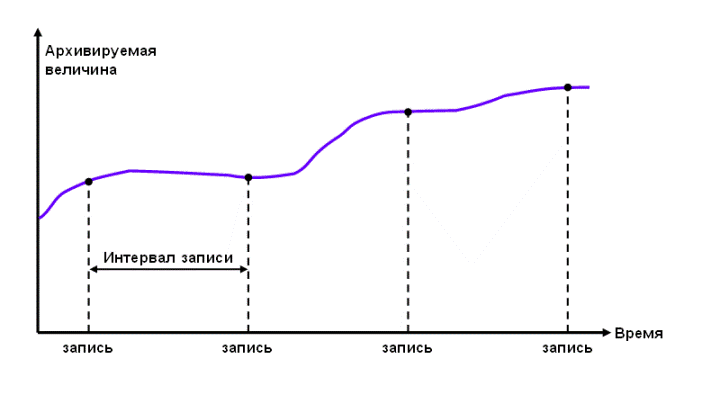
Рис. 1. Циклическая запись процессной переменной в архив.2. Архивация по изменению переменной (дельта-архивированиe, delta-archiving). Этот подход предполагает запись переменной в архив только тогда, когда изменение ее значения по сравнению с предыдущим записанным значением (абсолютная разность) достигает определенной величины (дельты, см. рис. 2). Дельта настраивается пользователем и может быть выражена как в абсолютных единицах измерения, так и в процентах от шкалы. Безусловно, это техника более экономична, чем циклическая запись, так как она адаптируется к скорости изменения архивируемой величины. Для дискретных величин – этот подход незаменим. Допустим, у нас есть дискретная переменная, которая изменяется, скажем, раз в час. Зачем же ее архивировать каждую секунду или минуту? Ведь гораздо логичнее записывать значение переменной в архив только в те моменты, когда это значение переходит из 1 в 0 или наоборот.
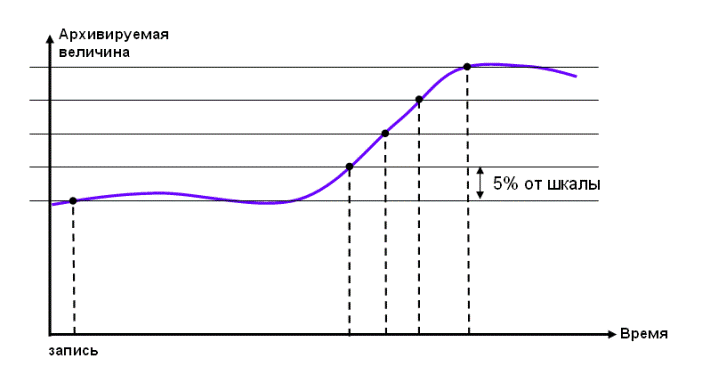
Рис. 2. Дельта-архивирование процессной переменной.Куда записывается архив процессных переменных?
Чаще всего используется один из трех вариантов:
1. Архив записывается в обычный текстовый файл в формате CSV ( comma separated values). Этот файл может храниться как на локальном, так и на сетевом диске. На самом деле архив состоит из множества последовательно создаваемых файлов: система генерирует новый файл архива каждую рабочую смену или сутки. У такого формата представления архива есть неоспоримое преимущество – его можно просмотреть любым текстовым редактором. Его также можно экспортировать в MS Excel и посмотреть в виде таблицы, применив необходимые сортировки и фильтры. Существенный недостаток – это неэкономичность хранения; накопленный таким образом архив занимает неприлично много места на жестком диске. Для уменьшения объема архива можно применить компрессию по алгоритму ZIP или RAR – благо, что текстовые файлы очень хорошо сжимаются.
2. Архив представляет собой двоичный файл, формат которого зависит от используемого ПО визуализации тех. процесса (SCADA). Очевидно, что это более экономичное представление архива, но для работы с ним обычным экселем уже не обойдешься. При этом формат архива у разных производителей SCADA может сильно различаться. Как и в предыдущем случае, архив состоит из последовательно создаваемых файлов. Вообще, хранить архив в одном большом файле – это не очень хорошо с точки зрения скорости доступа к данным.
3. Самый прогрессивный способ. Хранение архива в виде реляционной базы данных с поддержкой СУБД SQL. Этот способ позволяет достичь достаточно большой скорости работы с архивом (добавление записей, чтение и обработка данных), при этом сервер SQL может обеспечить оптимальный доступ к истории сразу нескольким десяткам удаленных клиентов. Поскольку доступ к архиву осуществляется по открытому интерфейсу SQL, разработчики имеют возможность создавать клиентские приложения под свои нужды. Но главное преимущество заключается в том, что архив на базе SQL – это отличная возможность для интеграции АСУ ТП с информационными системами более высокого уровня (например, уровня MES). Как правило, для ведения архива SQL и обслуживания клиентов используется достаточно мощная серверная платформа.
Во всех описанных случаях система архивирования процессных переменных – это неотъемлемая часть ПО визуализации технологического процесса. Разница заключается в формате представления архива и технологии доступа.
Какие средства служат для отображения архива? Архив можно отобразить несколькими способами. Самый простой – это представить его в табличной форме и экспортировать, например, в Excel, в котором можно строить графики, диаграммы и делать отчеты. Однако это довольно утомительно и требует много ручного труда.
Более удобный способ – это отображение истории в виде специального динамического (обновляемого автоматически) графика, называемого трендом ( trend). Тренд помещается на мнемосхемы операторского интерфейса в тех места, где это необходимо и удобно оператору. Пример тренда изображен на рисунке ниже.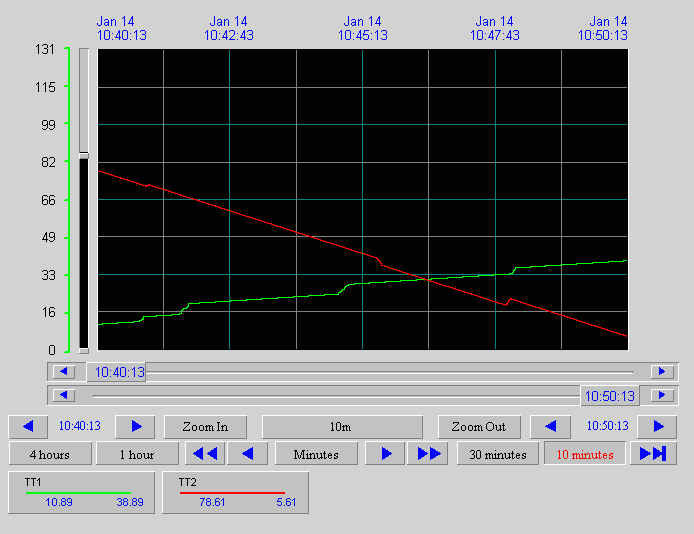
Рис. 3. Пример исторического тренда, отображающего две процессные переменные.На тренд можно выводить до 16 переменных одновременно, как дискретных, так и аналоговых. При этом тренд можно строить за произвольный промежуток времени ( time span). Также поддерживается масштабирование ( scaling). Передвигая ползунок ( slider) вдоль шкалы времени можно просматривать точные значения переменных в различные моменты времени в прошлом. Отрезки времени, в течение которых наблюдались аварийные значения переменных, выделяются на тренде контрастным цветом. В общем, тренды – это мощный и очень удобный инструмент, наглядно показывающий поведение переменных в динамике.
[ http://kazanets.narod.ru/AlarmsArchive.htm]
Тематики
EN
Русско-английский словарь нормативно-технической терминологии > процессные переменные
-
2 архивирование данных
архивирование данных
—
[ http://www.iks-media.ru/glossary/index.html?glossid=2400324]Возможность архивирования технологических параметров – неотъемлемое требование, предъявляемое ко всем современным системам управления. В действительности развитая система архивирования – это та характерная черта, которая отличает полнофункциональные РСУ от многочисленных, так сказать, "аналогов”.
Для чего же нужно архивирование технологических параметров?
По трем довольно простым причинам:
1. Архив значений технологических параметров (на техническом жаргоне “история”, history) позволяет оценить качество и эффективность осуществляемого системой управления. Это делается путем ретроспективного анализа ключевых технологических параметров, что позволяет судить о том, в какой мере достигнута поставленная цель управления.
2. Архивирование позволяет специалистам оценить динамику изменения технологических параметров за длительный период времени, что чрезвычайно полезно для понимания поведения процесса в различных (в том числе аварийных) ситуациях, а, следовательно, и пополнения знаний о конкретной технологии.
3. Архив может содержать информацию, помогающую установить причины возникновения различных аварийных и нештатных ситуаций. Так, тщательно изучив журнал действий оператора, специалист может определить, какая именно операция диспетчера привела к отклонению от регламента или, не дай Бог, аварии (можно предположить, что операторы не всегда в восторге от того, что каждое их действие протоколируется системой).
Какая же информация архивируется (пишется в историю)?
Грубо говоря, все данные, которые записываются в архив, можно разделить на три группы:
1. Процессные переменные ( process values);
2. Аварийные сигналы ( alarms);
3. Действия операторов-технологов ( operator actions).
[ http://kazanets.narod.ru/AlarmsArchive.htm]Тематики
EN
Русско-английский словарь нормативно-технической терминологии > архивирование данных
-
3 escala
f.1 scale.escala Celsius Celsius (temperature) scaleescala de Richter Richter scaleescala salarial salary scaleescala de valores set of values2 scale.una reproducción a escala a scale modelun dibujo a escala natural a life-size drawinga escala mundial on a worldwide scalea gran escala on a large scale3 stopover.hacer escala to stop oversin escala non-stopescala técnica refueling stop4 scale (Music).5 ladder (escalera).6 intermediate stop.7 staging post.pres.indicat.3rd person singular (él/ella/ello) present indicative of spanish verb: escalar.imperat.2nd person singular (tú) Imperative of Spanish verb: escalar.* * *1 (escalera - de mano) ladder; (- de tijera) stepladder2 (graduación) scale; (de colores) range3 (mapa, plano, etc) scale5 MÚSICA scale6 MILITAR promotion list\a gran escala / en gran escala on a large scaleen pequeña escala on a small scaleescala de gato rope ladderescala de valores scale of valuesescala móvil sliding scaleescala musical scale* * *noun f.1) range2) scale* * *SF1) [en medición, gradación] scale•
a escala — [dibujo, mapa, maqueta] scale antes de sun mapa hecho a escala — a map drawn to scale, a scale map
•
reproducir algo a escala — to reproduce sth to scaleescala de colores — colour spectrum, color spectrum (EEUU)
escala de tiempo — (Geol) time scale
escala de valores — set of values, scale of values
escala móvil — (Téc) sliding scale; (Econ) sliding salary scale
escala social — social ladder, social scale
2) [de importancia, extensión]un problema a escala mundial — a global problem, a problem on a worldwide scale
•
a o en gran escala — on a large scale•
a o en pequeña escala — on a small scaleun caso de corrupción a pequeña escala — a case of small-scale corruption, a case of corruption on a small scale
3) (=parada en ruta)a) (Aer) stopover•
hacer escala — to stop overb) (Náut) port of callescala técnica — refuelling o (EEUU) refueling stop
4) (=escalera de mano) ladderescala de cuerda, escala de viento — rope ladder
5) (Mús) scale* * *1) ( para mediciones) scale2) (Mús) scale3) ( escalafón)4)a) (de mapa, plano) scaleuna reproducción a escala natural — a life-size o life-sized reproduction
b) (de fenómeno, problema) scalea escala nacional — on a nationwide o national scale
a or en gran escala — on a large scale
5) (Aviac, Náut) stopover6) ( escalera) ladder* * *= echelon, magnitude, range, scale, scale, shade, spectrum [spectra, -pl.], continuum, gradation, stopover, rating scale, port of call, rating, sliding scale.Ex. Involvement of lower echelon personnel in planning has the advantage of getting the practical point of view of those closer to the scene of the operations.Ex. Only those who have attempted to edit the proceedings of a conference can appreciate the magnitude and scope of such an enterprise.Ex. Overall, the library media specialists experienced stress in the mild to moderate range.Ex. The scale of a map is the distance as shown on the map in relation to actual distance.Ex. Various scales of relevance ratings may be established.Ex. Partly because of the fact that documents have shades of relevance to a given topic this is an impossible objective.Ex. As one respondent from this end of the information spectrum put it, 'Context is all in the information world'.Ex. At the other end of the continuum is the form of hack writing typified by the poorest quality of adventure stories (often mildly pornographic).Ex. Until the mid nineteen hundreds, this community presented an almost feudal pattern of wealthy merchants and factory hands, with several gradations between these extremes.Ex. This article discusses the strategic location of the Islands as a stopover and spring-board for more far-flung explorations along the African coast.Ex. This process will allow institutional evaluators to compare their individual evaluations using a standardized format and rating scale.Ex. ' Ports of Call' is an enchanting, lovely, scary and sad book, as good as any.Ex. But the rater must not be afraid to give negative ratings.Ex. For insulin dosing, use a sliding scale based on patient weight as well as on blood sugar values.----* a + Adjetivo + escala = on a + Adjetivo + scale.* a escala = drawn-to-scale.* a escala industrial = on an industrial scale, industrial-scale.* a escala mundial = globally, on a global scale.* a escala natural = full-scale.* a gran escala = large scale [large-scale], massive, on a wide scale, high-volume, wide-scale, on a broad scale, in a big way, on a grand scale.* a menor escala = at a reduced rate.* a pequeña escala = in a small way, small scale [small-scale].* a un extremo de la escala = at one end of the scale.* en el otro extremo de la escala = at the other extreme.* en el otro extremo de la escala = at the other end of the scale, at the other end of the spectrum.* en otra escala = on a different plane.* en un extremo de la escala = at one extreme.* escala de ampliación = enlargement ratio.* escala de grises = grey scale [gray scale].* escala de reducción = reduction ratio.* escala de tarifas según los ingresos = sliding fee scale.* escala de valores = graded range, set of values.* escala de Wechsler = Wechsler scale.* escala móvil = sliding scale.* escala que consta de nueve grados = nine-point scale.* escala salarial = salary scale, pay scale, salary schedule, salary range, salary band, sliding pay scale.* escala temporal = time continuum.* estar hecho a escala = be to scale.* hacer escala = stop over.* IGE (Integración a Gran Escala) = LSI (Large Scale Integration).* IME (Integración a Media Escala) = MSI (Medium Scale Integration).* IPE (Integración a Pequeña Escala) = SSI (Small Scale Integration).* mención de escala = statement of scale.* Nombre + a gran escala = broad scale + Nombre.* puerto de escala = port of call.* seguir una escala = fall along + a continuum.* * *1) ( para mediciones) scale2) (Mús) scale3) ( escalafón)4)a) (de mapa, plano) scaleuna reproducción a escala natural — a life-size o life-sized reproduction
b) (de fenómeno, problema) scalea escala nacional — on a nationwide o national scale
a or en gran escala — on a large scale
5) (Aviac, Náut) stopover6) ( escalera) ladder* * *= echelon, magnitude, range, scale, scale, shade, spectrum [spectra, -pl.], continuum, gradation, stopover, rating scale, port of call, rating, sliding scale.Ex: Involvement of lower echelon personnel in planning has the advantage of getting the practical point of view of those closer to the scene of the operations.
Ex: Only those who have attempted to edit the proceedings of a conference can appreciate the magnitude and scope of such an enterprise.Ex: Overall, the library media specialists experienced stress in the mild to moderate range.Ex: The scale of a map is the distance as shown on the map in relation to actual distance.Ex: Various scales of relevance ratings may be established.Ex: Partly because of the fact that documents have shades of relevance to a given topic this is an impossible objective.Ex: As one respondent from this end of the information spectrum put it, 'Context is all in the information world'.Ex: At the other end of the continuum is the form of hack writing typified by the poorest quality of adventure stories (often mildly pornographic).Ex: Until the mid nineteen hundreds, this community presented an almost feudal pattern of wealthy merchants and factory hands, with several gradations between these extremes.Ex: This article discusses the strategic location of the Islands as a stopover and spring-board for more far-flung explorations along the African coast.Ex: This process will allow institutional evaluators to compare their individual evaluations using a standardized format and rating scale.Ex: ' Ports of Call' is an enchanting, lovely, scary and sad book, as good as any.Ex: But the rater must not be afraid to give negative ratings.Ex: For insulin dosing, use a sliding scale based on patient weight as well as on blood sugar values.* a + Adjetivo + escala = on a + Adjetivo + scale.* a escala = drawn-to-scale.* a escala industrial = on an industrial scale, industrial-scale.* a escala mundial = globally, on a global scale.* a escala natural = full-scale.* a gran escala = large scale [large-scale], massive, on a wide scale, high-volume, wide-scale, on a broad scale, in a big way, on a grand scale.* a menor escala = at a reduced rate.* a pequeña escala = in a small way, small scale [small-scale].* a un extremo de la escala = at one end of the scale.* en el otro extremo de la escala = at the other extreme.* en el otro extremo de la escala = at the other end of the scale, at the other end of the spectrum.* en otra escala = on a different plane.* en un extremo de la escala = at one extreme.* escala de ampliación = enlargement ratio.* escala de grises = grey scale [gray scale].* escala de reducción = reduction ratio.* escala de tarifas según los ingresos = sliding fee scale.* escala de valores = graded range, set of values.* escala de Wechsler = Wechsler scale.* escala móvil = sliding scale.* escala que consta de nueve grados = nine-point scale.* escala salarial = salary scale, pay scale, salary schedule, salary range, salary band, sliding pay scale.* escala temporal = time continuum.* estar hecho a escala = be to scale.* hacer escala = stop over.* IGE (Integración a Gran Escala) = LSI (Large Scale Integration).* IME (Integración a Media Escala) = MSI (Medium Scale Integration).* IPE (Integración a Pequeña Escala) = SSI (Small Scale Integration).* mención de escala = statement of scale.* Nombre + a gran escala = broad scale + Nombre.* puerto de escala = port of call.* seguir una escala = fall along + a continuum.* * *A (para mediciones) scaleCompuestos:Beaufort scale● escala centígrada or Celsius[ Vocabulary notes (Spanish) ] centigrade o Celsius scaleset of values[ Vocabulary notes (Spanish) ] Fahrenheit scaleMercalli scalesliding scaleRichter scalesalary o wage scaleB ( Mús) scaleCompuestos:chromatic scalediatonic scalemusical scaleC(escalafón): la escala social the social scaleD1 (de un mapa, plano) scaleun dibujo hecho a escala a scale drawing, a drawing done to scaleuna reproducción a escala natural a life-size o life-sized reproductionla maqueta reproduce el teatro a escala it's a scale model of the theater2 (de un fenómeno, problema) scalea escala nacional/mundial on a nationwide o national/on a worldwide scaleel negocio empezó a or en pequeña escala the business began on a small scaletodo lo hacen a or en gran escala they do everything on a large scalees un ladrón en pequeña escala he's a small-time thief ( colloq)tras una escala de tres horas en Atenas after a three-hour stopover in Athenshicimos/el avión hizó escala en Roma we/the plane stopped over in Romeun vuelo sin escalas a direct flightla primera escala será Tánger the first port of call will be TangiersCompuesto:refueling* stopel aparato tuvo que hacer una escala técnica en París the plane had to make a refueling stop o to stop for refueling in ParisF (escalera) ladderCompuestos:● escala de cuerda or de vientorope ladderroyal flushextending ladder* * *
Del verbo escalar: ( conjugate escalar)
escala es:
3ª persona singular (él/ella/usted) presente indicativo2ª persona singular (tú) imperativo
Multiple Entries:
escala
escalar
escala sustantivo femenino
1 ( en general) scale;◊ escala centígrada/Fahrenheit centigrade o Celsius/Fahrenheit scale;
escala de valores set of values;
escala musical (musical) scale;
la escala social the social scale;
hecho a escala done to scale;
a gran escala on a large scale
2 (Aviac, Náut) stopover;
escalar ( conjugate escalar) verbo transitivo ‹montaña/pared› to climb, scale;
(en jerarquía, clasificación) to climb (up)
verbo intransitivo (Dep) to climb, go climbing
escala sustantivo femenino
1 (serie, gradación) scale: la maqueta se realizó a escala, the model was made to scale
la escala decimal, decimal scale
2 (de colores) range
escala de valores, set of values
3 (parada provisional) Náut port of call
Av stopover: el avión hace escala en Barcelona, the plane stops over in Barcelona
escala técnica, refuelling stop
4 (escalera portátil) ladder, stepladder
5 (clasificación del personal de una empresa) position: subió de escala en la organización, he was promoted to a higher position in the company
6 (Mús) scale: tocó una escala muy alta, difícil de seguir con la voz, she played a very high scale which was difficult to sing
escalar
I verbo transitivo to climb, scale
II adjetivo Elec
♦ Locuciones: magnitud escalar, scalar quantitity
' escala' also found in these entries:
Spanish:
bastante
- do
- fa
- la
- re
- sol
- abajo
- arriba
- descendente
- mayor
- modelo
- nivel
- tarifa
English:
call in
- full-scale
- grade
- kit
- ladder
- large-scale
- model
- nationally
- nationwide
- originate
- point
- port of call
- price range
- put in
- range
- Richter scale
- rise
- scale
- scale down
- sliding scale
- small-scale
- stop
- stop off
- stop over
- stopover
- wholesale
- country
- full
- global
- put
- rope
- sliding
- time
* * *escala nf1. [para medir, ordenar] scale;[de colores] range; [de cargos militares] scale of ranks;subió varios puestos en la escala social he climbed several rungs of the social ladderescala Celsius Celsius (temperature) scale;escala centígrada Celsius scale;escala Fahrenheit Fahrenheit scale;Informát escala de grises grayscale;escala Kelvin Kelvin scale;Mat escala logarítmica logarithmic scale;escala de popularidad popularity stakes;escala de Richter Richter scale;escala salarial pay o salary scale;escala de valores set of values2. [de dibujo, mapa] scale;un mapa a escala 1/3000 a 1/3000 scale map;una reproducción a escala a scale model;un dibujo a escala natural a life-size drawing3. [de trabajo, plan, idea] scale;pretenden crear una casa de discos a escala reducida they aim to set up a small-scale record company;a escala nacional/mundial on a national/worldwide scale;una ofensiva a gran escala a full-scale offensive4. Mús scale;la escala musical the musical scaleescala cromática chromatic scale;escala diatónica diatonic scale5. [en un vuelo] stopover;[en un crucero] port of call;un vuelo a Estambul con escala en Roma a flight to Istanbul with a stopover in Rome;hacer escala (en) to stop over (in);sin escala non-stop;un vuelo sin escalas a non-stop flightescala de repostaje refuelling stop;escala técnica refuelling stop;haremos escala técnica en Londres we will make a refuelling stop in London6. [escalera] ladderNáut escala de cuerda rope ladder; Náut escala de viento rope ladder* * *f1 tbMÚS scale;a escala to scale, life-sized;a escala mundial on a world scale;en oa gran escala large-scale atr, on a large scale2 AVIA stopover;hacer escala en stop over in* * *escala nf1) : scale2) escalera: ladder3) : stopover* * *escala n1. (serie de cosas) scaleuna escala de 1:50 a scale of of 1:502. (parada) stopover -
4 gestión
f.1 step, move, step of a process, gestio.2 negotiation, management, undertaking, action.3 management.* * *1 (Also used in plural with the same meaning) (trámite) step, measure, move■ tengo que realizar varias gestiones, después nos veremos I have a few errands to do, so I'll see you later2 (comercial) administration, management■ la gestión de la empresa corre a cargo del hijo del dueño the owner's son is in charge of managing the company3 (Also used in plural with the same meaning) (negociación) negotiation\gestión de datos data management* * *noun f.1) management2) procedure* * *SF1) (=administración) managementgestión interna — (Inform) housekeeping
2) pl gestiones (=trámites)el gobierno tendrá que hacer las primeras gestiones — the government will have to make the first move
* * *a) ( trámite)hizo or efectuó gestiones para adoptar un niño — he went through the procedure for adopting a child
b) (Com, Fin) managementc) (Adm, Gob) administrationd) gestiones femenino plural ( negociaciones) negotiations (pl)* * *= handling, husbanding, management, manipulation, running, dispensation, stewardship, manning, managing, back office, keeping.Ex. The document can now be returned to the proper department for further handling.Ex. There is nevertheless some scope in some African countries for the exploitation of basic information technologies for such actitivies as the internal husbanding and sharing of decision-making data.Ex. The practice of librarianship requires performance of the same management functions irrespective of position.Ex. Indexing may rely upon the facilities for the manipulation and ordering of data offered by the computer.Ex. The acquisition of these materials is a skilful job demanding the sort of dedication that a housewife brings to the running of her home.Ex. The role of government publications in the provision of information is discussed as well as the new constitutional dispensation which came into being in September 1984 in the Republic of South Africa.Ex. The librarian's professional values include service, commitment to truth-seeking and intellectual freedom and a sense of responsibility ( stewardship of knowledge).Ex. All the things that follow in the chapter are subservient to the inquiry point and its proper manning.Ex. Compiling, updating, managing and editing monolingual and multilingual thesauri without suitable software is extremely complex.Ex. Benefits have been proven in the back office and now many organizations are applying it in customer facing applications.Ex. I am an associate director for collections development, and my responsibilities relate to the getting and keeping of collections = Soy subdirector encargado del desarrollo de la colección y mis responsabilidades están relaconadas con la adquisición y mantenimiento de las colecciones.----* analista de sistemas de gestión bibliotecaria = library systems analyst.* consultoría para la gestión = management consultant.* cursos de gestión de información = management course.* de gestión = back-office.* de gestión del museo = curatorial.* director ejecutivo de la gestión del conocimiento = knowledge executive.* economía de gestión = managerial economics.* encargado de la gestión de documentos = record(s) manager.* encargado de la gestión documental = record(s) manager.* equipo de gestión = management team.* escuela de gestión = business school.* estilo de gestión = managerial style, management style.* estrategia de gestión = management strategy, managerial strategy.* estrategia de gestión de la información = information management strategy.* estructura jerárquica de gestión = line management.* estudios de gestión = management science.* gasto de gestión = administration fee.* gastos de gestión = handling fee.* gestión administrativa = housekeeping.* gestión bibliotecaria = library management.* gestión compartida = shared governance.* gestión de aguas = water management.* gestión de archivos = management of records, archive(s) management.* gestión de archivos personales = personal archives management, personal records management.* gestión de bases de datos = database management.* gestión de calidad total = total quality management (TQM).* gestión de casos clínicos = case management.* gestión de crisis = crisis management.* gestión de datos = data handling.* gestión de documentación administrativa = record keeping [recordkeeping], record management [records management], record(s) management, paperwork management.* gestión de documentos = document management, handling of documents, record(s) management, record keeping [recordkeeping].* gestión de documentos electrónicos = electronic document management.* gestión de empresas = business management.* gestión de fincas = land management.* gestión de grandes extensiones para la cría de ganado = range management.* gestión de imágenes = imaging, image-handling, image management.* gestión de imágenes de documentos = document image management.* gestión de imágenes digitales = digital imaging, digital image management.* gestión de imágenes electrónicas = electronic image management.* gestión de imágenes por ordenador = computer imaging.* gestión de la biblioteca = library management, library administration.* gestión de la colección = collection management.* gestión de la información = information management, information handling.* gestión de la oferta de productos = range management.* gestión del catálogo = catalogue management.* gestión del comportamiento = behaviour management.* gestión del conocimiento = knowledge management (KM).* gestión del contenido = content management.* gestión del medio ambiente = environmental management.* Gestión de los Recursos de Información (IRM) = Information Resources Management (IRM).* gestión del tiempo = time management.* gestión de objetos = object management.* gestión de oficinas = office management.* gestión de operaciones = operations management.* gestión de personal = personnel management.* gestión de recursos acuáticos = aquatic resource management.* gestión de recursos acuíferos = water resource management.* gestión de recursos hidráulicos = water management.* gestión de recursos humanos = human resource management.* gestión de registros = record keeping [recordkeeping].* gestión de soportes = media management.* gestión de terrenos = land management.* gestión de tierras = land management.* gestión diaria de, la = day-to-day running of, the.* gestión documental = information management, record management [records management], record(s) management, record keeping [recordkeeping], record keeping [recordkeeping].* gestión económica = economics.* gestión electrónica de documentos = electronic record keeping, electronic record keeping, electronic record management.* gestión entre pares = collegial management.* gestiones = paperwork.* gestión financiera = fiscal management.* gestión mediante proyectos = project management.* gestión participativa = participative management.* gestión por objetivos = management by objectives (MBO).* gestión y conservación de documentos electrónicos = electronic document preservation and management.* grupo de gestión = management team.* herramienta de gestión = management tool, managerial tool.* herramienta para la gestión de la información = information-managing tool.* información de gestión = management data, management information.* jefe de los servicios de gestión del conocimiento = chief knowledge officer (CKO).* Licenciado en Gestión Empresarial = MBA (Master of Business Administration).* mala gestión = mismanagement.* método de gestión = managerial style.* nivel alto de gestión = higher management.* nivel medio de gestión = middle management.* para la gestión de información textual = text-handling.* profesional de la gestión documental = information management professional.* profesional encargado de la gestión de documentos = records professional.* programa de gestión bibliográfica personal = personal bibliographic software.* programa de gestión bibliotecaria = library software package.* programa de gestión de bases de datos = database management software.* programa de gestión de datos = database management software.* Programa de Gestión de Registros y Archivos (RAMP) = Records and Archives Management Programme (RAMP).* programa de gestión documental = information retrieval software.* programa de gestión financiera = cash management package, cash management software.* programa integrado de gestión de bibliotecas = integrated library system (ILS), integrated library management system (ILMS).* programas para la gestión de mapas = map software.* responsabilidad en la gestión = accountability.* responsable de la gestión de documentos = record(s) manager.* responsable de la gestión documental = record(s) manager.* sistema de ayuda a la gestión = management support system (MSS).* sistema de gestión bibliotecaria = library system, library management system.* sistema de gestión de documentos = record(s) system.* sistema de gestión de documentos electrónicos = electronic document management system (EDMS).* sistema de gestión de imágenes = imaging system, image-based system, image management system.* sistema de gestión de la información (SGI) = information management system (IMS).* sistema de gestión del conocimiento = knowledge management system (KMS).* Sistema de Gestión de Mensajes (MHS) = Message Handling System (MHS).* sistema de gestión de registros = record(s) system.* sistema de gestión documental = information retrieval system (IRS), record(s) system.* sistema integrado de gestión bibliotecaria = integrated library package.* sistema para la información de gestión = management information system (MIS).* sistema virtual de gestión de cursos = course management system.* sociedad de gestión de derechos de autor = copyright collective, copyright collecting society, copyright collecting agency.* teoría de la gestión = management theory.* * *a) ( trámite)hizo or efectuó gestiones para adoptar un niño — he went through the procedure for adopting a child
b) (Com, Fin) managementc) (Adm, Gob) administrationd) gestiones femenino plural ( negociaciones) negotiations (pl)* * *= handling, husbanding, management, manipulation, running, dispensation, stewardship, manning, managing, back office, keeping.Ex: The document can now be returned to the proper department for further handling.
Ex: There is nevertheless some scope in some African countries for the exploitation of basic information technologies for such actitivies as the internal husbanding and sharing of decision-making data.Ex: The practice of librarianship requires performance of the same management functions irrespective of position.Ex: Indexing may rely upon the facilities for the manipulation and ordering of data offered by the computer.Ex: The acquisition of these materials is a skilful job demanding the sort of dedication that a housewife brings to the running of her home.Ex: The role of government publications in the provision of information is discussed as well as the new constitutional dispensation which came into being in September 1984 in the Republic of South Africa.Ex: The librarian's professional values include service, commitment to truth-seeking and intellectual freedom and a sense of responsibility ( stewardship of knowledge).Ex: All the things that follow in the chapter are subservient to the inquiry point and its proper manning.Ex: Compiling, updating, managing and editing monolingual and multilingual thesauri without suitable software is extremely complex.Ex: Benefits have been proven in the back office and now many organizations are applying it in customer facing applications.Ex: I am an associate director for collections development, and my responsibilities relate to the getting and keeping of collections = Soy subdirector encargado del desarrollo de la colección y mis responsabilidades están relaconadas con la adquisición y mantenimiento de las colecciones.* analista de sistemas de gestión bibliotecaria = library systems analyst.* consultoría para la gestión = management consultant.* cursos de gestión de información = management course.* de gestión = back-office.* de gestión del museo = curatorial.* director ejecutivo de la gestión del conocimiento = knowledge executive.* economía de gestión = managerial economics.* encargado de la gestión de documentos = record(s) manager.* encargado de la gestión documental = record(s) manager.* equipo de gestión = management team.* escuela de gestión = business school.* estilo de gestión = managerial style, management style.* estrategia de gestión = management strategy, managerial strategy.* estrategia de gestión de la información = information management strategy.* estructura jerárquica de gestión = line management.* estudios de gestión = management science.* gasto de gestión = administration fee.* gastos de gestión = handling fee.* gestión administrativa = housekeeping.* gestión bibliotecaria = library management.* gestión compartida = shared governance.* gestión de aguas = water management.* gestión de archivos = management of records, archive(s) management.* gestión de archivos personales = personal archives management, personal records management.* gestión de bases de datos = database management.* gestión de calidad total = total quality management (TQM).* gestión de casos clínicos = case management.* gestión de crisis = crisis management.* gestión de datos = data handling.* gestión de documentación administrativa = record keeping [recordkeeping], record management [records management], record(s) management, paperwork management.* gestión de documentos = document management, handling of documents, record(s) management, record keeping [recordkeeping].* gestión de documentos electrónicos = electronic document management.* gestión de empresas = business management.* gestión de fincas = land management.* gestión de grandes extensiones para la cría de ganado = range management.* gestión de imágenes = imaging, image-handling, image management.* gestión de imágenes de documentos = document image management.* gestión de imágenes digitales = digital imaging, digital image management.* gestión de imágenes electrónicas = electronic image management.* gestión de imágenes por ordenador = computer imaging.* gestión de la biblioteca = library management, library administration.* gestión de la colección = collection management.* gestión de la información = information management, information handling.* gestión de la oferta de productos = range management.* gestión del catálogo = catalogue management.* gestión del comportamiento = behaviour management.* gestión del conocimiento = knowledge management (KM).* gestión del contenido = content management.* gestión del medio ambiente = environmental management.* Gestión de los Recursos de Información (IRM) = Information Resources Management (IRM).* gestión del tiempo = time management.* gestión de objetos = object management.* gestión de oficinas = office management.* gestión de operaciones = operations management.* gestión de personal = personnel management.* gestión de recursos acuáticos = aquatic resource management.* gestión de recursos acuíferos = water resource management.* gestión de recursos hidráulicos = water management.* gestión de recursos humanos = human resource management.* gestión de registros = record keeping [recordkeeping].* gestión de soportes = media management.* gestión de terrenos = land management.* gestión de tierras = land management.* gestión diaria de, la = day-to-day running of, the.* gestión documental = information management, record management [records management], record(s) management, record keeping [recordkeeping], record keeping [recordkeeping].* gestión económica = economics.* gestión electrónica de documentos = electronic record keeping, electronic record keeping, electronic record management.* gestión entre pares = collegial management.* gestiones = paperwork.* gestión financiera = fiscal management.* gestión mediante proyectos = project management.* gestión participativa = participative management.* gestión por objetivos = management by objectives (MBO).* gestión y conservación de documentos electrónicos = electronic document preservation and management.* grupo de gestión = management team.* herramienta de gestión = management tool, managerial tool.* herramienta para la gestión de la información = information-managing tool.* información de gestión = management data, management information.* jefe de los servicios de gestión del conocimiento = chief knowledge officer (CKO).* Licenciado en Gestión Empresarial = MBA (Master of Business Administration).* mala gestión = mismanagement.* método de gestión = managerial style.* nivel alto de gestión = higher management.* nivel medio de gestión = middle management.* para la gestión de información textual = text-handling.* profesional de la gestión documental = information management professional.* profesional encargado de la gestión de documentos = records professional.* programa de gestión bibliográfica personal = personal bibliographic software.* programa de gestión bibliotecaria = library software package.* programa de gestión de bases de datos = database management software.* programa de gestión de datos = database management software.* Programa de Gestión de Registros y Archivos (RAMP) = Records and Archives Management Programme (RAMP).* programa de gestión documental = information retrieval software.* programa de gestión financiera = cash management package, cash management software.* programa integrado de gestión de bibliotecas = integrated library system (ILS), integrated library management system (ILMS).* programas para la gestión de mapas = map software.* responsabilidad en la gestión = accountability.* responsable de la gestión de documentos = record(s) manager.* responsable de la gestión documental = record(s) manager.* sistema de ayuda a la gestión = management support system (MSS).* sistema de gestión bibliotecaria = library system, library management system.* sistema de gestión de documentos = record(s) system.* sistema de gestión de documentos electrónicos = electronic document management system (EDMS).* sistema de gestión de imágenes = imaging system, image-based system, image management system.* sistema de gestión de la información (SGI) = information management system (IMS).* sistema de gestión del conocimiento = knowledge management system (KMS).* Sistema de Gestión de Mensajes (MHS) = Message Handling System (MHS).* sistema de gestión de registros = record(s) system.* sistema de gestión documental = information retrieval system (IRS), record(s) system.* sistema integrado de gestión bibliotecaria = integrated library package.* sistema para la información de gestión = management information system (MIS).* sistema virtual de gestión de cursos = course management system.* sociedad de gestión de derechos de autor = copyright collective, copyright collecting society, copyright collecting agency.* teoría de la gestión = management theory.* * *1(trámite): la única gestión que había realizado the only step he had takenhizo or efectuó gestiones para adoptar un niño he went through the procedure for adopting a childsu apoyo a las gestiones de paz their support for the peace process o peace moveslas gestiones realizadas por sus compañeros the steps o action taken by his colleagueslas gestiones actualmente en marcha para resolverlo the efforts currently under way to resolve itunas gestiones que tenía que realizar some business that I had to attend toun balance sobre sus dos años de gestión a review of their two-year administration o of their two years in powerCompuestos:portfolio managementrisk managementtime management* * *
gestión sustantivo femenino
hizo gestiones para adoptar un niño he went through the procedure for adopting a child;
su apoyo a las gestiones de paz their support for the peace processb)
gestión sustantivo femenino
1 (de un negocio, empresa) management 2 gestiones, (conjunto de trámites) formalities, steps: están haciendo gestiones para liberarlos, they are working to free him
' gestión' also found in these entries:
Spanish:
bloquear
- excusada
- excusado
- recado
- trámite
- transparencia
- transparente
- diligencia
- paso
English:
collapse
- conduct
- course
- financial management
- management
- management accounting
- management consultancy
- management studies
- MBA
- mismanagement
- personnel management
- procedure
- running
- unproductive
- financial
- indictment
* * *gestión nf1. [diligencia]tengo que hacer unas gestiones en el ayuntamiento I have a few things to do at the town hall;las gestiones para obtener un visado the formalities involved in getting a visa;sus gestiones para obtener la beca no dieron fruto his efforts to get a grant were unsuccessful;las gestiones del negociador fracasaron the negotiator's efforts came to nothing;voy a intentar hacer unas gestiones a ver si puedo conseguirlo I'll try and speak to a few people to see if I can manage it;RPno hay peor gestión que la que no se hace there's no harm in trying2. [administración] managementgestión de calidad quality control; Fin gestión de cartera portfolio management; Com gestión de cobro = collection of outstanding payments;gestión de crisis crisis management;gestión de empresas business management;gestión financiera financial management;Com gestión de línea line management; Com gestión de personal personnel management;gestión política [de gobierno, ministro] conduct in government;gestión de recursos resource management;gestión de riesgos risk management;gestión del tiempo time managementgestión de memoria memory management4. [gobierno] administration;tres años de gestión del gobierno socialista three years under the socialist administration* * *f1 management;mala gestión mismanagement, poor management2:hacer gestiones attend to some business* * *1) trámite: procedure, step2) administración: management3) gestiones nfpl: negotiations* * *gestión n (administración) management -
5 intervenir
v.1 to tap.El tipo interviene el proyecto The guy tap the project.2 to seize (incautarse de).3 to audit (finance) (cuentas).La contraloría interviene a la empresa The comptroller audits the company.4 to take part.intervino en varias películas cómicas (en discusión, debate) she appeared in several comedy filmsen la evolución de la economía intervienen muchos factores several different factors play a part in the state of the economydespués del presidente intervino el Sr. Ramírez Mr Ramirez spoke after the president5 to intervene (interferir, imponer el orden).El juez interviene a veces The judge intervenes sometimes.6 to operate on, to perform surgery on, to make an intervention on.Te interviene el Dr. Pérez Dr. Perez makes an operation on you.7 to take over, to take control of, to take over the operation of.El socio interviene la empresa The associate takes over the operation of..8 to confiscate, to seize.La corte interviene sus bienes The court seized his belongings.* * *1 (tomar parte) to take part (en, in); (mediar) to intervene2 (interrumpir) to intervene3 (hablar) to speak (en, at)1 MEDICINA to operate on2 (alijo, mercancía) to seize3 (teléfono) to tap4 (cuentas) to audit* * *verb1) to intervene2) take part3) operate* * *1. VI1) (=tomar parte) to take partla reyerta en la que intervino el acusado — the brawl in which the defendant took part o was involved
2) (=injerirse) to intervenela policía intervino para separar a las dos pandillas — the police intervened to separate the two gangs
3) (=mediar)el presidente intervino para que se pudiera llegar a un acuerdo — the president mediated o interceded so that an agreement could be reached
las circunstancias que intervinieron en mi dimisión — the circumstances that influenced my resignation
2. VT1) (=controlar) to take over, take control ofla junta militar intervino todas las cadenas estatales — the junta took over o took control of all the state-run channels
el gobierno intervino a los ferroviarios — the government took over o took control of the railworkers' union
2) (Com) [+ cuenta] to audit; [+ banco, empresa] to take into administration; [+ cuenta, bienes] to freeze3) (Med) to operate on4) [+ droga, armas, patrimonio, bienes] to confiscate, seize5) [+ teléfono] to tap* * *1.verbo intransitivoa) (en debate, operación) to take part; ( en espectáculo) to appear, performb) ( mediar) to intervene, intercede (frml)c) ( tomar parte) to intervene2.intervenir vt1)a) < teléfono> to tapb) ( tomar control de) < empresa> to place... in administrationc) ( inspeccionar) < cuentas> to audit, inspectd) <armas/droga> to seize, confiscatee) (AmL) <universidad/emisora> to take over the running of, take control of2) ( operar) to operate on* * *= go into, have + a hand in, step in, intervene, jump in, obtrude (into), cut in, mediate, intersect, come into + play, call into + play, wiretap [wire-tap], weigh in, chime in.Ex. As something you may or may not know, every item going into the processing stream is assigned a priority, and our judgment will in many cases be different from yours, as our needs will be different from yours.Ex. For the benefit of all users of the thesaurus who have not had a hand in its initial compilation some written record describing the anticipated use of the thesaurus is valuable.Ex. Furthermore, children can be misled by group influences into reading truly pernicious material (hard core ponography, for example) and when this happens adults have a clear responsibility to step in and do something about it.Ex. And again, this is a point at which the teacher may need to intervene to provide examples.Ex. The unhappy tendency among teachers -- an occupational neurosis -- is to jump in too early and too often, especially if the talk wanders from direct comments about books under consideration.Ex. The librarian will provide whatever help is required without obtruding into the process.Ex. 'I'm not sure what 'arbitrary and capricious' means,' Stanton cut in reasonably.Ex. School library media professionals who mediate in the learning experiences of students must be well informed critical thinkers.Ex. Contingency plans can be devised to intersect at several points on this time continuum.Ex. There are, of course, all sorts of other considerations which come into play in determining the income which a publisher might obtain from a book.Ex. Ethical principles are called into play when deliberating about values, particularly when values run into conflict.Ex. The implementation of this system would enable law enforcement agencies to wiretap all digital communication.Ex. If Division VIII is best positioned to weigh in on terminology, Division VIII should do so and the rest of us should follow that lead.Ex. A few members of this list have done this, so wait for them to chime in here.----* intervenir con = chime in with.* intervenir en un conflicto = enter + conflict.* que intervienen = at play.* si no intervienen otros factores = ceteris paribus, all (other) things being equal.* * *1.verbo intransitivoa) (en debate, operación) to take part; ( en espectáculo) to appear, performb) ( mediar) to intervene, intercede (frml)c) ( tomar parte) to intervene2.intervenir vt1)a) < teléfono> to tapb) ( tomar control de) < empresa> to place... in administrationc) ( inspeccionar) < cuentas> to audit, inspectd) <armas/droga> to seize, confiscatee) (AmL) <universidad/emisora> to take over the running of, take control of2) ( operar) to operate on* * *= go into, have + a hand in, step in, intervene, jump in, obtrude (into), cut in, mediate, intersect, come into + play, call into + play, wiretap [wire-tap], weigh in, chime in.Ex: As something you may or may not know, every item going into the processing stream is assigned a priority, and our judgment will in many cases be different from yours, as our needs will be different from yours.
Ex: For the benefit of all users of the thesaurus who have not had a hand in its initial compilation some written record describing the anticipated use of the thesaurus is valuable.Ex: Furthermore, children can be misled by group influences into reading truly pernicious material (hard core ponography, for example) and when this happens adults have a clear responsibility to step in and do something about it.Ex: And again, this is a point at which the teacher may need to intervene to provide examples.Ex: The unhappy tendency among teachers -- an occupational neurosis -- is to jump in too early and too often, especially if the talk wanders from direct comments about books under consideration.Ex: The librarian will provide whatever help is required without obtruding into the process.Ex: 'I'm not sure what 'arbitrary and capricious' means,' Stanton cut in reasonably.Ex: School library media professionals who mediate in the learning experiences of students must be well informed critical thinkers.Ex: Contingency plans can be devised to intersect at several points on this time continuum.Ex: There are, of course, all sorts of other considerations which come into play in determining the income which a publisher might obtain from a book.Ex: Ethical principles are called into play when deliberating about values, particularly when values run into conflict.Ex: The implementation of this system would enable law enforcement agencies to wiretap all digital communication.Ex: If Division VIII is best positioned to weigh in on terminology, Division VIII should do so and the rest of us should follow that lead.Ex: A few members of this list have done this, so wait for them to chime in here.* intervenir con = chime in with.* intervenir en un conflicto = enter + conflict.* que intervienen = at play.* si no intervienen otros factores = ceteris paribus, all (other) things being equal.* * *intervenir [ I31 ]vi1 (en un debate) to take part; (en un espectáculo) to appear, perform; (en una operación) to take partintervino ante el director a nuestro favor she intervened o interceded on our behalf with the directoren mi decisión han intervenido muchos factores many factors have had a bearing on my decision3 (involucrarse, inmiscuirse) to intervene, get involvedno pensamos intervenir en los problemas internos de otros países we do not intend intervening o getting involved in the internal affairs of other countrieslos profesores tuvieron que intervenir en la pelea the teachers had to intervene to stop the fightno quiso intervenir en la pelea he didn't want to get involved in the fight■ intervenirvtA1 ‹teléfono› to tap2 (tomar control de) ‹empresa› to place … in administration3 (inspeccionar) ‹cuentas› to audit, inspect4 ‹armas/droga› to seize, confiscate5 ( AmL) ‹universidad/emisora› to take over the running of, take control ofB (operar) to operate onfue intervenido en una clínica privada he had his operation o he was operated on o he underwent surgery in a private clinic* * *
intervenir ( conjugate intervenir) verbo intransitivo
( en espectáculo) to appear, perform
intervenir en una pelea to intervene o step in to stop a fight;
( involucrarse) to get involved in a fight
verbo transitivo
1
2 ( operar) to operate on;
intervenir
I vi (mediar) to intervene [en, in]
(participar) to take part [en, in]: me gustaría intervenir en el debate, I'd like to take part in the debate
II verbo transitivo
1 (un alijo de droga, etc) to confiscate, to seize: la policía ha intervenido la droga en la frontera, the police seized the drugs at the border
2 (bloquear una cuenta bancaria) to block o freeze: el juez ha intervenido su cuenta, the judge froze his bank account
(auditar) to audit
3 (un teléfono) to tap: me parece que la línea está intervenida, I think they put a tap on our phone
4 Med (a un paciente) to operate on: le van a intervenir mañana a las nueve, they're performing her surgery tomorrow at nine o'clock
' intervenir' also found in these entries:
Spanish:
mediar
- terciar
English:
intervene
- join in
- step in
- interest
- move
- operate
- step
- tap
* * *♦ vt3. [teléfono, línea] to tap;[correspondencia] to open4. [incautarse de] to seize5. Am [institución privada] to put into administration♦ vi1. [participar] to take part (en in); [en pelea, discusión] to get involved (en in);intervino en varias películas cómicas she appeared in several comedy films;en la evolución de la economía intervienen muchos factores several different factors play a part in the state of the economy;después del presidente intervino el Sr. Ramírez Mr Ramirez spoke after the president;yo quisiera intervenir para decir que no estamos de acuerdo con la propuesta I would just like to say something: we do not agree with the proposal;¿alguien más quisiera intervenir sobre esta cuestión? would anyone else like so say something on this issue?2. [interferir, imponer el orden] to intervene (en in);la policía tuvo que intervenir para separar a las dos aficiones the police had to intervene to separate the two groups of fans3. [mediar] to intervene, to intercede;su padre intervino ante su madre para que lo dejara salir his father spoke to his mother to persuade her to let him go out;la ONU intervino para lograr un acuerdo the UN intervened o interceded in order to get an agreement* * *II v/t1 TELEC tap2 contrabando seize3 MED operate on* * *intervenir {87} vi1) : to take part2) interceder: to intervene, to intercedeintervenir vt1) : to control, to supervise2) : to audit3) : to operate on4) : to tap (a telephone)* * *intervenir vb1. (interponerse) to intervene3. (operar) to operate on -
6 correctamente
adv.1 correctly; accurately.2 regularly.3 politely; properly, fittingly.4 correctly, duly, truly, right.* * *► adverbio1 (sin errores) correctly, accurately2 (con educación) correctly, politely, properly* * *ADV1) (=exactamente) correctly, accurately2) (=decentemente) correctly, politely* * *a) ( sin errores) correctlyb) ( con cortesía) politelyc) ( honestamente) honorably* * *= accurately, correctly, properly, successfully, rightly, aright, with due process, rightfully.Ex. Headings tend to be broad and cannot represent complex or specific subjects accurately.Ex. Computers are reliable, and less prone to error provided they are instructed or programmed appropriately and correctly.Ex. This group of fields should be completed before the fixed fields are entered, because the record type is needed for handling these fields properly.Ex. Without AACR is doubtful whether computerised cataloguing would have been implemented so relatively painlessly and successfully = Sin las RCAA es dudoso que la catalogación automatizada se hubiera implementado tan fácilmente y con tanto éxito, relativamente hablando.Ex. Democracy, rightly understood, is a positive creed and its political and social values would be greatly strengthened if the library service was planned on national lines to support them.Ex. Another wise precaution at this preliminary stage is to make sure that he has heard aright.Ex. One must be able to prove that a new staff member was selected with due process and with clearly delineated criteria.Ex. It must be remembered that AACR does not follow the Paris Principles completely, as Mr. Lubetzky quite rightfully and disappointedly pointed out.----* actuar correctamente = do + the right thing, get on + the right side of.* comportarse correctamente = get on + the right side of.* no actuar correctamente = be remiss.* * *a) ( sin errores) correctlyb) ( con cortesía) politelyc) ( honestamente) honorably* * *= accurately, correctly, properly, successfully, rightly, aright, with due process, rightfully.Ex: Headings tend to be broad and cannot represent complex or specific subjects accurately.
Ex: Computers are reliable, and less prone to error provided they are instructed or programmed appropriately and correctly.Ex: This group of fields should be completed before the fixed fields are entered, because the record type is needed for handling these fields properly.Ex: Without AACR is doubtful whether computerised cataloguing would have been implemented so relatively painlessly and successfully = Sin las RCAA es dudoso que la catalogación automatizada se hubiera implementado tan fácilmente y con tanto éxito, relativamente hablando.Ex: Democracy, rightly understood, is a positive creed and its political and social values would be greatly strengthened if the library service was planned on national lines to support them.Ex: Another wise precaution at this preliminary stage is to make sure that he has heard aright.Ex: One must be able to prove that a new staff member was selected with due process and with clearly delineated criteria.Ex: It must be remembered that AACR does not follow the Paris Principles completely, as Mr. Lubetzky quite rightfully and disappointedly pointed out.* actuar correctamente = do + the right thing, get on + the right side of.* comportarse correctamente = get on + the right side of.* no actuar correctamente = be remiss.* * *1 (sin errores) correctly2 (con cortesía) politely* * *
correctamente adverbio
' correctamente' also found in these entries:
Spanish:
acertar
- bien
- esclusa
English:
function
- properly
- right
- rightly
- correctly
- politely
* * *correctamente adv1. [contestar] correctly2. [comportarse] courteously;se comportó distantemente con nosotros pero correctamente he was distant but very correct in the way he behaved towards us* * *correctamente adv1. (sin errores) correctly2. (con educación) properly / politely -
7 mezclado
adj.1 mixed.2 motley, mixed-up.past part.past participle of spanish verb: mezclar.* * *SM mixing* * *= jumbled, blended, merged, intermingled.Ex. Found that examples of shoddy production -- missing issues, jumbled titles, poor photography -- were commonplace.Ex. There is an overarching need to establish a shared set of values that defines the blended organisation.Ex. We are convinced that this process will go a long way towards breaking down the few barriers that still exist between the merged entities that make up Learning Services.Ex. These are analogous, or rather synonymous, terms with intermingled aims and objectives and as such they need some elucidation.* * *= jumbled, blended, merged, intermingled.Ex: Found that examples of shoddy production -- missing issues, jumbled titles, poor photography -- were commonplace.
Ex: There is an overarching need to establish a shared set of values that defines the blended organisation.Ex: We are convinced that this process will go a long way towards breaking down the few barriers that still exist between the merged entities that make up Learning Services.Ex: These are analogous, or rather synonymous, terms with intermingled aims and objectives and as such they need some elucidation.* * *mixingoperaciones de mezclado mixing processconsola de mezclado ( Audio) mixing desk -
8 приводить
reduce, reduce to, bring, cite, deduce, list, adduce, enter• Были приведены дальнейшие аргументы, показавшие, что... - Further arguments were given which showed that...• Было бы легко привести значительно больше примеров... - It would be easy to give many more examples of...• В основном, различные подходы приводят к... - Different approaches will, in general, lead to...• В свою очередь это может привести к тому, что... - This in turn can lead to...• В таблице 1 мы приводим вместе все данные относительно... - In Table 1 we summarize the...• В этом приложении мы приводим результаты... - In this appendix we present the results of...• Все эти данные приводили к очевидному требованию, что... - All this evidence led to a clear requirement that...• Дальнейшее рассуждение затем привело бы к идее... - Further argument would then lead to the idea of...• Данная процедура может быть продолжена, она приводит к... - The procedure can be continued, yielding...• Здесь мы приводим другой пример (чего-л). - We give here another example of...• Здесь мы приводим некоторые формулы для... - Неге we give some formulae for...• Исследование каждого случая отдельно приводит к... - Examination of each individual case leads to...• Можно привести еще одно замечание. - One further observation may be made.• Мы можем привести геометрическую интерпретацию для... -It is possible to give a geometric interpretation of...• Мы не можем привести здесь полный ответ. - We cannot give a complete answer here.• Мы не приводим это рассуждение со всеми подробностями по следующим причинам. - We do not present this argument in detail for the following reasons.• Мы приводим ниже значения для... - We quote below the values of...• Мы теперь приведем приложение уравнения (5). - We now give an application of (5).• Это привело нас к предложению, что... - We are led to the suggestion that...• Наши рассуждения в предыдущем параграфе могли бы привести нас к предположению, что... - Our work in the previous section might lead us to suspect that...• Однако здесь можно привести очень грубый довод. - A very rough reason, however, can be given here.• Описанный здесь метод всегда приводит... - The procedure described here always yields...• Перед тем как продолжить приводить примеры, мы приведем важное замечание, что... - Before proceeding to give examples, we make the important observation that...• Подобные повреждения могут привести к потере... - Such injuries can result in a loss of...• Понятно, что только один этот процесс не мог бы привести к... - Clearly such a process alone could not lead to...• Предыдущее обсуждение приводит к идее, что... - The preceding discussion leads to the idea that...• Приведем более полное доказательство, данное Гильбертом [2]. - A fuller proof, given by Hilbert [2], is as follows.• Приведем исключения, которые указывает Смит [1]. - Smith [1] points out certain exceptions as follows.• Приведем некоторый основной критерий для... - Let us list some major criteria for...• Приведем соответствующие численные величины:... - The corresponding numerical values are as follows:...• Приведем теперь пример, в котором... - We now give an example in which...• Процесс приводит к замене в... - The process leads to a change in...• Следовательно, мы обязаны попытаться развить теорию, которая приводит к... - Hence, we must try to develop a theory that leads to...• Смит [1] приводит убедительный пример существования... - Smith [l] makes a persuasive case for the existence of...• Сначала мы приведем некоторый дополнительный материал относительно... - We begin with some additional material relating to...• Сначала мы приведем один результат из... - We first quote a result from...• Такая практика приводит к серьезным недоразумениям. - This practice leads to serious confusion.• Тем не менее эта формальная работа привела к конкретному результату. - Nevertheless, this formal work has produced a concrete result. I• Тем самым нас довольно настойчиво приводит к идее, что... - This suggests quite strongly that...• Теперь мы приведем некоторые экспериментальные данные относительно... - We shall now give some experimental data concerning...• Теперь мы приведем список наиболее важных тождеств, включающих... - We shall now list the most important identities involving...• Теперь мы приведем явную характеристику... - We now give an explicit characterization of...• Теперь приведем несколько конкретных примеров. - A few concrete examples are in order.• Чтобы привести еще более простой пример, мы можем рассмотреть... - То take an even simpler example, we can consider...• Элегантное доказательство, которое мы здесь приводим, в основном принадлежит Гильберту. - The elegant proof we give is essentially due to Hilbert.• Эти кажущиеся тривиальными результаты приводят к... - These seemingly trivial results lead to...• Эти результаты мы приводим в таблице 1 для трех значений г. - The results are set out in Table 1 for three values of r.• Это выражение можно привести к более удобному виду. - This expression can be put in a more convenient form.• Это доказательство слишком сложное, чтобы приводить его здесь. - The proof is too complicated to give here.• Это естественным образом приводило к различным схемам для... - It led naturally to various schemes for...• Это заключение базируется на тех же самых идеях, которые приводят к... - This conclusion is based on the same ideas that lead to...• Это могло бы также привести к лучшему пониманию... - This could also lead to a better understanding of...• Это не приведет к ошибке, потому что... - This will not give rise to confusion because...• Это не приводит ни к каким концептуальным трудностям, однако... - This introduces no conceptual difficulties, but...• Это нестрогое рассуждение приводит нас к... - This crude argument leads to...• Это позволяет нам привести уравнение (1) к следующему виду... - This enables us to reduce (1) to the form...• Это привело нескольких авторов к заключению, что... - This has led several authors to believe that...• Это приводит к возникновению так называемого... - This gives rise to the so-called...• Это приводит к возрастанию... - This involves an increase in...• Это приводит к выводу, что... - This carries the implication that...• Это приводит к концепции... - This leads to a conception in which...• Это приводит к новым концепциям. - This leads to new conceptions.• Это приводит к полезным методам обращения с... - This leads to useful ways of dealing with...• Это приводит к противоречию, и, следовательно, доказательство закончено. - This gives a contradiction, and the proof is complete.• Это приводит к рассмотрению темы... - This leads into the topic of...• Это приводит к следующему определению. - This motivates the following definition.• Это приводит к тому, что известно как... - This leads to what is known as...• Это приводит нас к важному свойству... - This leads us to an important property of...• Это приводит нас к идее постулировать существование... - This leads us to postulate the existence of...• Этот результат автоматически приводит к необходимости изучения... - This result automatically leads to a study of... -
9 БИБЛИОГРАФИЯ
Мы приняли следующие сокращения для наиболее часто упоминаемых книг и журналов:IJP - International Journal of Psycho-analysisJAPA - Journal of the American Psychoanalytic AssociationSE - Standard Edition of the Complete Psychological Works of Sigmund Freud, ed. James Strachey (London: Hogarth Press and the Institute of Psycho-Analysis, 1953—74.)PSOC - Psychoanalytic Study of the Child (New Haven: Yale University Press)PQ - Psychoanalytic QuarterlyWAF - The Writings of Anna Freud, ed. Anna Freud (New York: International Universities Press, 1966—74)PMC - Psychoanalysis The Major Concepts ed. Burness E. Moore and Bernard D. Fine (New Haven: Yale University Press)\О словаре: _about - Psychoanalytic Terms and Concepts\1. Abend, S. M. Identity. PMC. Forthcoming.2. Abend, S. M. (1974) Problems of identity. PQ, 43.3. Abend, S. M., Porder, M. S. & Willick, M. S. (1983) Borderline Patients. New York: Int. Univ. Press.4. Abraham, K. (1916) The first pregenital stage of libido. Selected Papers. London, Hogarth Press, 1948.5. Abraham, K. (1917) Ejaculatio praecox. In: selected Papers. New York Basic Books.6. Abraham, K. (1921) Contributions to the theory of the anal character. Selected Papers. New York: Basic Books, 1953.7. Abraham, K. (1924) A Short study of the development of the libido, viewed in the light of mental disorders. In: Selected Papers. London: Hogarth Press, 1927.8. Abraham, K. (1924) Manic-depressive states and the pre-genital levels of the libido. In: Selected Papers. London: Hogarth Press, 1949.9. Abraham, K. (1924) Selected Papers. London: Hogarth Press, 1948.10. Abraham, K. (1924) The influence of oral erotism on character formation. Ibid.11. Abraham, K. (1925) The history of an impostor in the light of psychoanalytic knowledge. In: Clinical Papers and Essays on Psychoanalysis. New York: Basic Books, 1955, vol. 2.12. Abrams, S. (1971) The psychoanalytic unconsciousness. In: The Unconscious Today, ed. M. Kanzer. New York: Int. Univ. Press.13. Abrams, S. (1981) Insight. PSOC, 36.14. Abse, D W. (1985) The depressive character In Depressive States and their Treatment, ed. V. Volkan New York: Jason Aronson.15. Abse, D. W. (1985) Hysteria and Related Mental Disorders. Bristol: John Wright.16. Ackner, B. (1954) Depersonalization. J. Ment. Sci., 100.17. Adler, A. (1924) Individual Psychology. New York: Harcourt, Brace.18. Akhtar, S. (1984) The syndrome of identity diffusion. Amer. J. Psychiat., 141.19. Alexander, F. (1950) Psychosomatic Medicine. New York: Norton.20. Allen, D. W. (1974) The Feat- of Looking. Charlottesvill, Va: Univ. Press of Virginia.21. Allen, D. W. (1980) Psychoanalytic treatment of the exhibitionist. In: Exhibitionist, Description, Assessment, and Treatment, ed. D. Cox. New York: Garland STPM Press.22. Allport, G. (1937) Personality. New York: Henry Holt.23. Almansi, R. J. (1960) The face-breast equation. JAPA, 6.24. Almansi, R. J. (1979) Scopophilia and object loss. PQ, 47.25. Altman, L. Z. (1969) The Dream in Psychoanalysis. New York: Int. Univ. Press.26. Altman, L. Z. (1977) Some vicissitudes of love. JAPA, 25.27. American Psychiatric Association. (1987) Diagnostic and Statistical Manual of Mental Disorders, 3d ed. revised. Washington, D. C.28. Ansbacher, Z. & Ansbacher, R. (1956) The Individual Psychology of Alfred Adler. New York: Basic Books.29. Anthony, E. J. (1981) Shame, guilt, and the feminine self in psychoanalysis. In: Object and Self, ed. S. Tuttman, C. Kaye & M. Zimmerman. New York: Int. Univ. Press.30. Arlow. J. A. (1953) Masturbation and symptom formation. JAPA, 1.31. Arlow. J. A. (1959) The structure of the deja vu experience. JAPA, 7.32. Arlow. J. A. (1961) Ego psychology and the study of mythology. JAPA, 9.33. Arlow. J. A. (1963) Conflict, regression and symptom formation. IJP, 44.34. Arlow. J. A. (1966) Depersonalization and derealization. In: Psychoanalysis: A General Psychology, ed. R. M. Loewenstein, L. M. Newman, M. Schur & A. J. Solnit. New York: Int. Univ. Press.35. Arlow. J. A. (1969) Fantasy, memory and reality testing. PQ, 38.36. Arlow. J. A. (1969) Unconscious fantasy and disturbances of mental experience. PQ, 38.37. Arlow. J. A. (1970) The psychopathology of the psychoses. IJP, 51.38. Arlow. J. A. (1975) The structural hypothesis. PQ, 44.39. Arlow. J. A. (1977) Affects and the psychoanalytic situation. IJP, 58.40. Arlow. J. A. (1979) Metaphor and the psychoanalytic situation. PQ, 48.41. Arlow. J. A. (1979) The genesis of interpretation. JAPA, 27 (suppl.).42. Arlow. J. A. (1982) Problems of the superego concept. PSOC, 37.43. Arlow. J. A. (1984) Disturbances of the sense of time. PQ, 53.44. Arlow. J. A. (1985) Some technical problems of countertransference. PQ, 54.45. Arlow, J. A. & Brenner, C. (1963) Psychoanalytic Concepts and the Structural Theory, New York: Int. Univ. Press.46. Arlow, J. A. & Brenner, C. (1969) The psychopathology of the psychoses. IJP, 50.47. Asch, S. S. (1966) Depression. PSOC, 21.48. Asch, S. S. (1976) Varieties of negative therapeutic reactions and problems of technique. JAPA, 24.49. Atkins, N. (1970) The Oedipus myth. Adolescence, and the succession of generations. JAPA, 18.50. Atkinson, J. W. & Birch, D. (1970) The Dynamics of Action. New York: Wiley.51. Bachrach, H. M. & Leaff, L. A. (1978) Analyzability. JAPA, 26.52. Bacon, C. (1956) A developmental theory of female homosexuality. In: Perversions,ed, S. Lorand & M. Balint. New York: Gramercy.53. Bak, R. C. (1953) Fetishism. JAPA. 1.54. Bak, R. C. (1968) The phallic woman. PSOC, 23.55. Bak, R. C. & Stewart, W. A. (1974) Fetishism, transvestism, and voyeurism. An American Handbook of Psychiatry, ed. S. Arieti. New York: Basic Books, vol. 3.56. Balint, A. (1949) Love for mother and mother-love. IJP, 30.57. Balter, L., Lothane, Z. & Spencer, J. H. (1980) On the analyzing instrument, PQ, 49.58. Basch, M. F. (1973) Psychoanalysis and theory formation. Ann. Psychoanal., 1.59. Basch, M. F. (1976) The concept of affect. JAPA, 24.60. Basch, M. F. (1981) Selfobject disorders and psychoanalytic theory. JAPA, 29.61. Basch, M. F. (1983) Emphatic understanding. JAPA. 31.62. Balldry, F. Character. PMC. Forthcoming.63. Balldry, F. (1983) The evolution of the concept of character in Freud's writings. JAPA. 31.64. Begelman, D. A. (1971) Misnaming, metaphors, the medical model and some muddles. Psychiatry, 34.65. Behrends, R. S. & Blatt, E. J. (1985) Internalization and psychological development throughout the life cycle. PSOC, 40.66. Bell, A. (1961) Some observations on the role of the scrotal sac and testicles JAPA, 9.67. Benedeck, T. (1949) The psychosomatic implications of the primary unit. Amer. J. Orthopsychiat., 19.68. Beres, C. (1958) Vicissitudes of superego functions and superego precursors in childhood. FSOC, 13.69. Beres, D. Conflict. PMC. Forthcoming.70. Beres, D. (1956) Ego deviation and the concept of schizophrenia. PSOC, 11.71. Beres, D. (1960) Perception, imagination and reality. IJP, 41.72. Beres, D. (1960) The psychoanalytic psychology of imagination. JAPA, 8.73. Beres, D. & Joseph, E. D. (1965) Structure and function in psychoanalysis. IJP, 46.74. Beres, D. (1970) The concept of mental representation in psychoanalysis. IJP, 51.75. Berg, M D. (1977) The externalizing transference. IJP, 58.76. Bergeret, J. (1985) Reflection on the scientific responsi bilities of the International Psychoanalytical Association. Memorandum distributed at 34th IPA Congress, Humburg.77. Bergman, A. (1978) From mother to the world outside. In: Grolnick et. al. (1978).78. Bergmann, M. S. (1980) On the intrapsychic function of falling in love. PQ, 49.79. Berliner, B. (1966) Psychodynamics of the depressive character. Psychoanal. Forum, 1.80. Bernfeld, S. (1931) Zur Sublimierungslehre. Imago, 17.81. Bibring, E. (1937) On the theory of the therapeutic results of psychoanalysis. IJP, 18.82. Bibring, E. (1941) The conception of the repetition compulsion. PQ, 12.83. Bibring, E. (1953) The mechanism of depression. In: Affective Disorders, ed. P. Greenacre. New York: Int. Univ. Press.84. Bibring, E. (1954) Psychoanalysis and the dynamic psychotherapies. JAPA, 2.85. Binswanger, H. (1963) Positive aspects of the animus. Zьrich: Spring.86. Bion Francesca Abingdon: Fleetwood Press.87. Bion, W. R. (1952) Croup dynamics. IJP, 33.88. Bion, W. R. (1961) Experiences in Groups. London: Tavistock.89. Bion, W. R. (1962) A theory of thinking. IJP, 40.90. Bion, W. R. (1962) Learning from Experience. London: William Heinemann.91. Bion, W. R. (1963) Elements of Psychoanalysis. London: William Heinemann.92. Bion, W. R. (1965) Transformations. London: William Heinemann.93. Bion, W. R. (1970) Attention and Interpretation. London: Tavistock.94. Bion, W. R. (1985) All My Sins Remembered, ed. Francesca Bion. Adingdon: Fleetwood Press.95. Bird, B. (1972) Notes on transference. JAPA, 20.96. Blanck, G. & Blanck, R. (1974) Ego Psychology. New York: Columbia Univ. Press.97. Blatt, S. J. (1974) Levels of object representation in anaclitic and introjective depression. PSOC, 29.98. Blau, A. (1955) A unitary hypothesis of emotion. PQ, 24.99. Bleuler, E. (1911) Dementia Praecox or the Group of Schizophrenias. New York: Int. Univ. Press, 1951.100. Blos, P. (1954) Prolonged adolescence. Amer. J. Orthopsychiat., 24.101. Blos, P. (1962) On Adolescence. New York: Free Press.102. Blos, P. (1972) The epigenesia of the adult neurosis. 27.103. Blos, P. (1979) Modification in the traditional psychoanalytic theory of adolescent development. Adolescent Psychiat., 8.104. Blos, P. (1984) Son and father. JAPA_. 32.105. Blum, G. S. (1963) Prepuberty and adolescence, In Studies ed. R. E. Grinder. New York: McMillan.106. Blum, H. P. Symbolism. FMC. Forthcoming.107. Blum, H. P. (1976) Female Psychology. JAPA, 24 (suppl.).108. Blum, H. P. (1976) Masochism, the ego ideal and the psychology of women. JAPA, 24 (suppl.).109. Blum, H. P. (1980) The value of reconstruction in adult psychoanalysis. IJP, 61.110. Blum, H. P. (1981) Forbidden quest and the analytic ideal. PQ, 50.111. Blum, H. P. (1983) Defense and resistance. Foreword. JAFA, 31.112. Blum, H. P., Kramer, Y., Richards, A. K. & Richards, A. D., eds. (1988) Fantasy, Myth and Reality: Essays in Honor of Jacob A. Arlow. Madison, Conn.: Int. Univ. Press.113. Boehm, F. (1930) The femininity-complex In men. IJP,11.114. Boesky, D. Structural theory. PMC. Forthcoming.115. Boesky, D. (1973) Deja raconte as a screen defense. PQ, 42.116. Boesky, D. (1982) Acting out. IJP, 63.117. Boesky, D. (1986) Questions about Sublimation In Psychoanalysis the Science of Mental Conflict, ed. A. D. Richards & M. S. Willick. Hillsdale, N. J.: Analytic Press.118. Bornstein, B. (1935) Phobia in a 2 1/2-year-old child. PQ, 4.119. Bornstein, B. (1951) On latency. PSOC, 6.120. Bornstein, M., ed. (1983) Values and neutrality in psychoanalysis. Psychoanal. Inquiry, 3.121. Bowlby, J. (1960) Grief and morning in infancy and early childhood. PSOC. 15.122. Bowlby, J. (1961) Process of mourning. IJP. 42.123. Bowlby, J. (1980) Attachment and Loss, vol. 3. New York: Basic Books.124. Bradlow, P. A. (1973) Depersonalization, ego splitting, non-human fantasy and shame. IJP, 54.125. Brazelton, T. B., Kozlowsky, B. & Main, M. (1974) The early motherinfant interaction. In: The Effect of the Infant on Its Caregiver, ed. M. Lewis & L. Rosenblum New York Wiley.126. Brenner, C. (1957) The nature and development of the concept of repression in Freud's writings. PSOC, 12.127. Brenner, C. (1959) The masochistic character. JAPA, 7.128. Brenner, C. (1973) An Elementary Textbook of Psycho-analysis. New York Int. Univ. Press.129. Brenner, C. (1974) On the nature and development of affects PQ, 43.130. Brenner, C. (1976) Psychoanalytic Technique and Psychic Conflict. New York: Int. Univ. Press.131. Brenner, C. (1979) The Mind in Conflict. New York: Int. Univ. Press.132. Brenner, C. (1979) Working alliance, therapeutic alliance and transference. JAPA, 27.133. Brenner, C. (1981) Defense and defense mechanisms. PQ, 50.134. Brenner, C. (1983) Defense. In: the Mind in Conflict. New York Int. Univ. Press.135. Bressler, B. (1965) The concept of the self. Psychoanalytic Review, 52.136. Breuer, J. & Freud, S. (1983—95) Studies on Hysteria. SE, 3.137. Breznitz, S., ed. (1983) The Denial of Stress. New York: Int. Univ. Press.138. Brody, S. (1964) Passivity. New York: Int. Univ. Press.139. Brown, H. (1970) Psycholinquistics. New York: Free Press.140. Bruner, J. S. (1964) The course of cognitive growth. Amer. Psychologist. 19.141. Bruner, J., Jolly, A. & Sylva, K. (1976) Play. New York Basic Books.142. Bruner, J. E., Olver, R. R. &Greenfield, P. M. (1966) Studies in Cognitive Growth. New York: Wiley.143. Buie, D H. (1981) Empathy. JAPA, 29.144. Burgner, M. & Edgeumble, R. (1972) Some problems in the conceptualization of early object relationships. PSOC, 27.145. Call, J. ed. (1979) Basic Handbook of Child Psychiatry. New York: Basic Books.146. Carroll, G. (1956) Language, Thought and Reality. Cambridge & London: M. I. T. Press & John Wiley.147. Cavenar, J. O. & Nash, J. L. (1976) The effects of Combat on the normal personality. Comprehensive Psychiat., 17.148. Chassequet-Smirgel, J. (1978) Reflections on the connection between perversion and sadism. IJP, 59.149. Chomsky, N. (1978) Language and unconscious knowledge. In: Psychoanalysis and Language, ed. J. H. Smith. New Haven: Yale Univ. Press, vol. 3.150. Clower, V. (1975) Significance of masturbation in female sexual development and function. In: Masturbation from Infancy to Senescence, ed. I. Marcus & J. Francis. New York: Int. Uni" Press.151. Coen, S. J. & Bradlow, P. A. (1982) Twin transference as a compromise formation. JAPA, 30.152. Compton, A. Object and relationships. PMC. Forthcoming.153. Cullen, W. (1777) First Lines of the Practice of Psysic. Edinburgh: Bell, Brandfute.154. Curtis, B. C. (1969) Psychoanalytic understanding and treatment of impotence. In: Sexual Function and Dysfunction, ed. P. J. Fink & V. B. O. Hummett. Philadelphia: F. A. Davis.155. Darwin, C. (1874) The Descent of Man. New York: Hurst.156. Davidoff-Hirsch, H. (1985) Oedipal and preoedipal phenomena. JAPA, 33.157. Davis, M. & Wallbridge, D. (1981) Boundary and Space. New York: Brunner-Mazel.158. Deutsch, H. (1932) Homosexuality in women. PQ, 1.159. Deutsch, H. (1934) Some forms of emotional disturbance and their relationship to schizophrenia. PQ, 11.160. Deutsch, H. (1937) Absence of grief. PQ, 6.161. Deutsch, H. (1942) Some forms of emotional disturbance and their relationship to schizophrenia. PQ, 11.162. Deutsch, H. (1955) The impostor. In: Neuroses and Character Types. New York: Int. Univ. Press, 1965.163. Devereux, G. (1953) Why Oedipus killed Lains. IJP, 34.164. Dewald, P. (1982) Psychoanalytic perspectives On resistance. In: resistance, Psychodynamics. and Behavioral Approaches, ed. P. Wachtel. New York: Plenum Press.165. Dickes, R. (1963) Fetishistic behavior. JAPA. 11.166. Dickes, R. (1965) The defensive function of an altered state of consciousness. JAPA, 13.167. Dickes, R. (1967) Severe regressive disruption of the therapeutic alliance. JAPA, 15.168. Dickes, R. (1981) Sexual myths and misinformation. In: Understanding Human Behaviour in Health and Illness, ed. R. C. Simon & H. Pardes. Baltimore: Williams & Wilkins.169. Dorpat, T. L. (1985) Denial and Defense in the Therapeutic Situation. New York: Jason Aronson.170. Downey, T. W. (1978) Transitional phenomena in the analysis of early adolescent males. PSOC, 33.171. Dunbar, F. (1954) Emotions and Bodily Functions. New York: Columbia Univ. Press.172. Easson, W. M. (1973) The earliest ego development, primitive memory traces, and the Isakower phenomenon. PQ, 42.173. Edelheit, H. (1971) Mythopoiesis and the primal scene. Psychoanal. Study Society, 5.174. Edgcumbe, R. & Burgner, M. (1972) Some problems in the conceptualization of early object relation ships, part I. PSOC, 27.175. Edgcumbe, R. & Burgner, M. (1975) The phallicnarcissistic phase. PSOC, 30.176. Eidelberg, L. (1960) A third contribution to the study of slips of the tongue. IJP, 41.177. Eidelberg, L. (1968) Encyclopedia of Psychoanalysis. New York: The Free Press; London: Collier-MacMillan.178. Eissler, K. R. (1953) The effect of the structure of the ego on psychoanalytic technique. JAPA, 1.179. Ellenberg, H. F. (1970) The Discovery of the Unconscious. New York: Basic Books.180. Emde, R. N. (1980) Toward a psychoanalytic theory of affect: I. & G. H. Pollock. Washington NYMH.181. Emde R., Gaensbaner, T. & Harmon R. (1976) Emotional Expression in Infancy. New York: Int. Univ. Press.182. Erode R. & Harmon, R. J. (1972) Endogenous and exogenous smiling systems in early infancy. J. Amer. Acad. Child Psychiat., 11.183. Engel, G. L. (1962) Psychological Development in Health and Disease. New York Saunders.184. Engel, G. L. (1967) Psychoanalytic theory of somatic disorder. JAPA, 15.185. Engel, G. L. (1968) A reconsideration of the role of conversion in somatic disease. Compr. Psychiat., 94.186. English, H. B. & English, A. C. (1958) A comprehensive Dictionary of Psychological and Psychoanalytical Terms. New York: David McKay.187. Erard, R. (1983) New wine in old skins. Int. Rev. Psychoanal., 10.188. Erdelyi, M. H. (1985) Psychoanalysis. New York: W. H. Freeman.189. Erikson, E. H. (1950) Childhood and Society. New York: Norton.190. Erikson, E. H. (1956) The concept of ego identity. JAPA, 4.191. Erikson, E. H. (1956) The problem of ego identity. JAPA, 4.192. Esman, A. H. (1973) The primal scene. PSOC, 28.193. Esman, A. H. (1975) The Psychology of Adolescence. New York: Int. Univ. Press.194. Esman, A. H. (1979) Some reflections on boredom. JAPA, 27.195. Esman, A. H. (1983) The "stimulus barrier": a review and reconsideration. PSOC, 38.196. Fairbairn, W. R. D. (1952) Psychoanalytic Studies of the Personality. London: Routledge & Kegan Paul.197. Fairbairn, W. R. D. (1954) An Object-Relations Theory of the Personality. New York: Basic Books.198. Fairbairn, W. R. D. (1963) Synopsis of an Object-Relations theory of the personality. IJP, 44.199. Fawcett, J., Clark, D. C., Scheftner, W. H. & Hedecker, D. (1983) Differences between anhedonia and normal hedonic depressive states. Arch. Gen. Psychiat., 40.200. Fenichel, O. (1934) On the psychology of boredom. Collected Papers. New York: Norton, 1953, vol. 1.201. Fenichel, O. (1941) Problems of Psychoanalytic Technique. Albany, N. Y.: Psychoanalytic Quaterly.202. Fenichel, O. (1945) Character disorders. In: The Psychoanalytic Theory of the Neurosis. New York: Norton.203. Fenichel, O. (1945) The Psychoanalytic Theory of Neurosis New York: Norton.204. Fenichel, O. (1954) Ego strength and ego weakness. Collected Papers. New York: Norton, vol. 2.205. Ferenczi, S. (1909) Introjection and transference. In: Sex in Psychoanalysis. New York: Basic Books.206. Ferenczi, S. (191617) Disease or patho-neurosis. The Theory and Technique of Psychoanalysis. London: Hogarth Press, 1950.207. Ferenczi, S. (1925) Psychoanalysis of sexual habits. In: The Theory and Technique of Psychoanalysis. New York: Basic Books.208. Fine, B. D., Joseph, E. D. & Waldhorn, H. F., eds. (1971) Recollection and Reconstruction in Psychoanalysis. Monograph 4, Kris Study Group. New York: Int. Univ. Press.209. Fink, G. (1967) Analysis of the Isakower phenomenon. JAPA, 15.210. Fink, P. J. (1970) Correlation between "actual" neurosis and the work of Masters and Johson. P. Q, 39.211. Finkenstein, L. (1975) Awe premature ejaculation. P. Q, 44.212. Firestein, S. K. (1978) A review of the literature. In: Termination in Psychoanalysis. New York: Int. Univ. Press.213. Fisher, C. et. al. (1957) A study of the preliminary stages of the construction of dreams and images. JAPA, 5.214. Fisher, C. et. al. (1968) Cycle of penile erection synchronous with dreaming (REM) sleep. Arch. Gen. Psychiat., 12.215. Fliess, R. (1942) The metapsychology of the analyst. PQ, 12.216. Fliess, R. (1953) The Revival of Interest in the Dream. New York: Int. Univ. Press.217. Fodor, N. & Gaynor, F. (1950) Freud: Dictionary of Psycho-analysis. New York: Philosophical Library.218. Fordham, M. (1969) Children as Individuals. London: Hodder & Stoughton.219. Fordham, M. (1976) The Self and Autism. London: Academic Press.220. Fraiberg, S. (1969) Object constancy and mental representation. PSOC, 24.221. Frank, A. Metapsychology. PMS. Forthcoming.222. Frank, A. & Muslin, H. (1967) The development of Freud's concept of primal repression. PSOC, 22.223. Frank, H. (1977) Dynamic patterns for failure in college students. Can. Psychiat. Ass. J., 22.224. French, T. & Fromm, E. (1964) Dream Interpretation. New York: Basic Books.225. Freud, A. (1936) The Ego and the Mechanisms of Defense. New York Int. Univ. Press.226. Freud, A. (1951) Observations on child development. PSOC, 6.227. Freud, A. (1952) The mutual influences in the development of ego and id. WAF, 4.228. Freud, A. (1958) Adolescence. WAF, 5.229. Freud, A. (1962) Assessment of childhood disturbances. PSOC, 17.230. Freud, A. (1962) Comments on psychic trauma. In: Furst (1967).231. Freud, A. (1963) The concept of developmental lines. PSOC, 18.232. Freud, A. (1965) Assessment of pathology, part 2. WAF, 6.233. Freud, A. (1965) Normality and Pathology in Childhood. New York: Int. Univ. Press.234. Freud, A. (1970) The infantile neurosis. WAF, 7.235. Freud, A. (1971) Comments on aggression. IJP, 53.236. Freud, A. (1971) The infantile neurosis. PSOC, 26.237. Freud, A. (1981) Insight. PSOC, 36.238. Freud, S. (1887—1902) Letters to Wilhelm Fliess. New York: Basic Books, 1954.239. Freud, S. (1891) On the interpretation of the aphasias. SE, 3.240. Freud, S. (1893—95) Studies on hysteria. SE, 2.241. Freud, S. (1894) The neuropsychoses of defence. SE, 3.242. Freud, S. (1895) On the ground for detaching a particular syndrome from neurasthenia under the description "anxiety neurosis". SE, 3.243. Freud, S. (1895) Project for a scientific psychology. SE, 1.244. Freud, S. (1896) Draft K, Jameary 1, 1896, Neuroses of defense (A Christmas fairytale). In: Extracts from the Fliess papers (1892—99).245. Freud, S. (1896) Further remarks on the neuropsychosis of defense. SE, 3.246. Freud, S. (1896) Heredity and aetiology of neurosis. SE, 3.247. Freud, S. (1898) Sexuality in the aetiology of the neurosis. SE, 3.248. Freud, S. (1899) Screen memories. SE, 3.249. Freud, S. (1900) The interpretation of dreams. SE, 4—5.250. Freud, S. (1901) Childhood memories and screen memories SE, 6.251. Freud, S. (1901) On dreams. SE, 5.252. Freud, S. (1901) The psychopathology of everyday life. SE, 6.253. Freud, S. (1905) Fragments of an analysis of a case of hysteria. SE, 7.254. Freud, S. (1905) Jokes and their relation to the unconscious. SE, 8.255. Freud, S. (1905) Psysical (or mental) treatment. SE, 7.256. Freud, S. (1905) Three essays on the theory of sexuality. SE. 7.257. Freud, S. (1908) Character and anal erotism. SE, 9.258. Freud, S. (1908) On the sexual theories of children. SE, 9.259. Freud, S. (1908) Preface to Wilhelm Stekel's Nervous Anxiety-States and Their Treatment. SE, 9.260. Freud, S. (1909) Analysis of a phobia in a five-year-old boy. SE, 10.261. Freud, S. (1909) Family romances. SE, 9.262. Freud, S. (1909) Notes upon a case of obsessional neurosis. SE, 10.263. Freud, S. (1910) A special type of choice of object made by men. SE, 11.264. Freud, S. (1910) The autithentical meaning of primal words. SE, 11.265. Freud, S. (1910) The future prospects of psychoanalytic therapy. SE, 11.266. Freud, S. (1910) The psychoanalytic view of psychogenic disturbance of vision. SE, 11.267. Freud, S. (1911) Formulations on the two principles of mental functioning. SE, 12.268. Freud, S. (1911) Notes on a case of paranoia. SE, 12.269. Freud, S. (1911) Psychoanalytic notes on an autobiographical account of a case of paranoia. SE, 12.270. Freud, S. (1911—15) Papers on technique. SE, 12.271. Freud, S. (1912) Contribution to a discussion on masturbation. SE, 12.272. Freud, S. (1912) On the universal tendency to abasement in the sphere of love. SE, 11.273. Freud, S. (1912) The dynamics of transference. SE, 12.274. Freud, S. (1913) Editor's note The disposition to obsessional neurosis. SE, 12.275. Freud, S. (1913) On beginning the treatment. SE, 12.276. Freud, S. (1913) Totem and taboo. SE, 13.277. Freud, S. (1914) Fausse reconnaissance (deja reconte) in psychoanalytic treatment. SE, 13.278. Freud, S. (1914) Mourning and melancholia. SE, 15.279. Freud, S. (1914) Observations on transference love. SE, 12.280. Freud, S. (1914) On narcissism. SE. 14.281. Freud, S. (1914) On the history of the psychoanalytic movement. SE, 14.282. Freud, S. (1914) Remembering, repeating, and working-through. SE, 12.283. Freud, S. (1914—16) Some character types met with in psychoanalysis. (II) Those wrecked by success SE, 14.284. Freud, S. (1915) Das UnbewuЯte. Gesammelte Werke, 10.285. Freud, S. (1915) Instincts and their vicissitudes. SE, 14.286. Freud, S. (1915) Observation on transference-love. SE, I2.287. Freud, S. (1915) Repression. SE, 14.288. Freud, S. (1915) The unconscious. SE, 14.289. Freud, S. (1915—17) Introductory lectures on psychoanalysis. SE, 15 & 16.290. Freud, S. (1916) Introductory lectures on psychoanalysis. SE, 16.291. Freud, S. (1916) Some character types met with in psychoanalytic work. SE, 16.292. Freud, S. (1917) A metapsychological supplement to the theory of dreams. SE, 14.293. Freud, S. (1917) Introductory lectures on psychoanalysis. SE, 16.294. Freud, S. (1917) Mourning and melancholia. SE, 14.295. Freud, S. (1917) On transformations of instinct as exemplified in anal erotism. SE, 17.296. Freud, S. (1918) From the history of an infantile neurosis. SE, 17.297. Freud, S. (1919) "A child is being beaten". SE, 17.298. Freud, S. (1919) Lines of advance in psychoanalytic therapy. SE, 17.299. Freud, S. (1919) The uncanny. SE, 17.300. Freud, S. (1920) Beyond the pleasure principle. SE, 18.301. Freud, S. (1920) The Psychogenesis of a case of homosexuality in a woman. SE, 18.302. Freud, S. (1921) Group psychology and the analysis of the ego. SE, 18.303. Freud, S. (1923) The ego and the id. SE, 19.304. Freud, S. (1923) The infantile genital organization. SE, 19.305. Freud, S. (1924) A short account of psychoanalysis. SE, 19.306. Freud, S. (1924) Neurosis and psychosis. SE, 19.307. Freud, S. (1924) The dissolution of the Oedipus complex SE, 19.308. Freud, S. (1924) The economic problem of masochism. SE, 19.309. Freud, S. (1924) The loss of reality in neurosis and psychosis. SE, 19.310. Freud, S. (1925) Negation. SE, 19.311. Freud, S. (1925) Some psychical consequences of the anatomical distinction between the sexes. SE, 19.312. Freud, S. (1926) Inhibitions, symptoms and anxiety. SE, 20.313. Freud, S. (1926) The question of lay analysis. SE, 20.314. Freud, S. (1927) Fetishism. SE, 21.315. Freud, S. (1930) Civilization and its discontents. SE, 21.316. Freud, S. (1931) Female sexuality. SE, 21.317. Freud, S. (1931) Libidinal types. SE, 21.318. Freud, S. (1933) Femininity. SE, 22,.319. Freud, S. (1933) New introductory lectures on psycho-analysis. SE, 22.320. Freud, S. (1933) The psychology of women. New introductory lectures on psychoanalysis. SE, 22.321. Freud, S. (1936) A disturbance of memory on the Acropolis. SE, 22.322. Freud, S. (1937) Analysis terminable and interminable. SE, 23.323. Freud, S. (1937) Constructions in analysis. SE, 23.324. Freud, S. (1938) An outline on psychoanalysis. SE, 23.325. Freud, S. (1938) Splitting of the ego in the process of defense. SE, 23.326. Freud, S. (1939) Moses and monotheism. SE, 23.327. Freud, S. (1940) An outline of psychoanalysis. SE, 23.328. Frosch, J. (1966) A note on reality constancy. In: Psychoanalysis — A General Psychology, ed. R. M. Loewenstein, L. M. Newman, M. Schur & A. J. Solnit. New York: Int. Univ. Press.329. Frosch, J. (1967) Delusional fixity sense of conviction and the psychotic conflict. IJP, 48.330. Frosch, J. (1977) The relation between acting out and disorders of impulse control. Psychiatry, 40.331. Frosch, J. (1980) Neurosis and psychosis. In: The Course of Life, ed. S. J. Greenspan & G. H. Pollock. Washington, D. C.: National Institute of Health, vol. 3.332. Frosch, J. (1983) The Psychotic Process. New York: Int. Univ. Press.333. Furer, M. (1972) The history of the superego concept in psychoanalysis. In: Moral Value and the Superego concept in Psychoanalysis, ed. S. C. Fost. New York: Int. Univ. Press.334. Furman, E. (1974) A Child s Parent Dies. New Heaven: Yale Univ. Press.335. Furman, E. (1980) Transference and externalization. PSOC, 35.336. Furst, S. Trauma. PMC, Forthcoming.337. Furst, S. (1967) Psychic trauma. In: Psychic Trauma, ed. S. S. Furst. New York: Basic Books.338. Furst, S. (1978) The stimulus barrier and the pathogenecity of trauma. IJP, 59.339. Gaddini, R. (1978) Transitional object and the psychosomatic symptom. In: Grolnich et. al. (1978).340. Galenson, E. & Roiphe, H. (1976) Some suggested revisions concerning early female development. JAPA, 24(5).341. Galenson, E. & Roiphe, H. (1980) The preoedipal development of the boy. JAPA, 28.342. Galenson, E. & Roiphe, H. (1981) Infantile Origins of Sexual Identity. New York: Int. Univ. Press.343. Ganzarain, R. Group psychology. PMC. Forthcoming.344. Ganzarain, R. (1980) Psychotic-like anxieties and primitive defenses. Issues on Ego Psychology, 3(2).345. Ganzarain, R. (1988) A comparative study of Bion's concepts about groups. In: Object Relations Group Psychotherapy. Madison, Ct.: Int. Univ. Press.346. Gediman, H. K. (1971) The concept of the stimulus barrier. IJP, 52.347. Gedo, J. & Goldberg, A. (1973) Models of the Mind. Chicago & London: Univ. of Chicago Press.348. Geerts, A. E. & Prechardt, E., reporters (1978) Colloquium on "trauma". IJP, 59.349. Gero, G. (1943) The idea of psychogenesis in modern psychiatry and in psychoanalysis. Psychoanal. Rev., 30.350. Gill. M. M. (1963) Topography and Systems in Psychoanalytic Theory. Psychol. Issues, Monogr. 10. New York: Int. Univ. Press.351. Gill. M. M. (1967) The primary process in motives and thought. In: Motives and Thought, ed. R. R. Holt. New York: Int. Univ. Press.352. Gill. M. M. (1974) Psychoanalysis and psychotherapy. Int. Rev. Psychoanal., 11.353. Gill, M. M & Rapaport, D. (1942) A case of amnesia and its bearing on the theory of memory. Character and Personality, 11.354. Gillespie, W. (1956) The general theory of Sexual perversion. IJP, 37.355. Glenn, J. (in press) A parameter. In: Annu. Psychoanal.356. Glenn, J. & Kaplan, E. H. (1968) Types of orgasm in women. JAPA, 16.357. Glower, E. (1929) The "screening" function of traumatic memories. IJP, 4.358. Glower, E. (1931) Sublimation, substitution, and social anxiety. IJP, 12.359. Glower, E. (1933) The relation of perversion-formation to the development of reality sense. IJP, 14.360. Glower, E. (1955) The terminal phase. In: The Technique of Psychoanalysis. New York: Int. Univ. Press.361. Goldberg, A. (1975) The evolution of psychoanalytic concepts of depression. In: Depression and Human Existence, ed. E. J. Anthony & T. Benedeck. Boston: Little, Brown.362. Goldberg, A. ed. (1978) The Psychology of the Self. New York: Int. Univ. Press.363. Goldberg, A. (1983) Self psychology and alternate perspectives on internalization. In: Reflections on Self Psychology, ed. J. Lichtenberg & S. Kaplan. Hillsdale, N. J.: Analytic Press.364. Green, A. (1978) Potential space in Psychoanalysis. In: Grolnich et. al. (1978).365. Greenacre, P. (1949) A contribution to the study of screen memories. FSOC, 3/4.366. Greenacre, P. (1950) General problems of acting out. PQ, 19.367. Greenacre, P. (1950) Special problems of early female sexual development. In: Trauma, Growth and Personality New York: Int. Univ. Press.368. Greenacre, P. (1952) Pregenital patterning. IJP, 33.369. Greenacre, P. (1953) Penis awe and its relation to penis envy. In: Drives, Affects, Behavior, ed. R. M. Loewenstein. New York: Int. Univ. Press.370. Greenacre, P. (1956) Experiences of awe in childhood. PSOC,11.371. Greenacre, P. (1957) The childhood of the artist. PSOC, 12.372. Greenacre, P. (1958) The family romance of the artist. In: Emotional Growth. New York: Int. Univ. Press, 1971, vol. 2.373. Greenacre, P. (1958) The relation of the impostor to the artist. In: Emotional Growth. New York: Int. Univ. Press, 1971, vol. 1.374. Greenacre, P. (1968) Perversions. PSOC, 23.375. Greenacre, P. (1969) The fetish and the transitional object, part 1. PSOC, 24.376. Greenacre, P. (1970) The fetish and the transitional object, part 2. IJP 51, vol. 4.377. Greenacre, P. (1970) The transitional object and the fetish. In: Emotional Growth. New York: Int. Univ. Press.378. Greenacre, P. (1972) Crowds and crisis. PSOC, 27.379. Greenacre, P. (1973) The primal scene and the sense of reality. PQ, 42.380. Greenacre, P. (1975) On reconstruction. JAPA, 21.381. Greenberg, J. R. & Mitchell, S. A. (1983) Object Relations in Psychoanalytic Theory. Cambridge: Harvard Univ. Press.382. Greenson, R. R. (1949) The psychology of apathy. PQ, 18.383. Greenson, R. R. (1953) On boredom. JAPA, 1.384. Greenson, R. R. (1960) Empathy and its vicissitudes. IJP, 41.385. Greenson, R. R. (1962) On enthusiasm. JAPA, 10.386. Greenson, R. R. (1965) The working alliance and the transference neurosis. PQ, 34.387. Greenson, R. R. (1967) The technique and Practice of Psycho-analysis. New York: Int. Univ. Press.388. Greenson, R. R. (1978) Exploration in Psychoanalysis. New York: Int. Univ. Press.389. Greenspan, S. & Pollock, G., eds. (1980) The Course of Life. Vol. I. Washington, D. C.: U. S. Government Printing office.390. Grinberg, L., Sor, D. & Tabak de Bianchedi, E. (1975) Introduction to the Work of Bion, trans. A. Hahn. Scotland: Clunie Press.391. Grinker, E. R (1945) Psychiatric disorders in combat crews overseas and in returnees. Med. Clin. North. Amer., 29.392. Grinstein, A. (1983) Freud's Rules of Dream Interpretation. New York: Int. Univ. Press.393. Grolnick, S., Barkin, L. & Muensterberger, W., eds. (1978) Between Reality and Fantasy. New York: Jason Aronson.394. Grosskurth, P. (1986) Melanie Klein. New York: Alfred Knopf.395. Grossman, W. E. & Stewart, W. A. (1976) Penis envy. JAPA, 24 (5).396. Grotstein, J. S. (1981) Splitting and Projective Indentification. New York: Jason Aronson.397. Guntrip, H. (1961) Personality Structure and Human Interaction. New York: Int. Univ. Press.398. Guntrip, H. (1968) Schizoid Phenomena, Object-Relations and the Self. London: Hogarth Press.399. Harley, M. (1967) Transference developments in a five-year old child. In: the Child Analyst at Work, ed. E. Geleerd. New York: Int. Univ. Press.400. Harley, M. (1974) Analyst and Adolescent at Work. New York: Quadrangle.401. Harley, M. (1986) Child analysis, 1947—1984, a retrospective. PSOC, 41.402. Harre, R. and Lamb, R. (1983) The Encyclopedia Dictionary of Psychology. Cambridge: M. I. T. Press.403. Harrison, J. B. (1975) On the maternal origins of awe. PSOC, 30.404. Harrison, J. B. (1979) On Freud's view of the infant-mother relationship and of the oceanic feeling. JAPA, 27.405. Harrison, S. J. (1970) Is psychoanalysis "our science?". JAPA, 18.406. Hartmann, H. PSOC, 5.407. Hartmann, H. (1937) Ego Psychology and the Problem of Adaptation. New York: Int. Univ. Press.408. Hartmann, H. (1939) Ego Psychology and the Problem of Adaptation. New York: Int. Univ. Press, 1958.409. Hartmann, H. (1939) Psychoanalysis and the concept of health. In: Hartmann (1964).410. Hartmann, H. (1947) On rational and irrational action. In: Essays on Ego Psychology. New York: Int. Univ. Press, 1964.411. Hartmann, H. (1948) Comments on the theory of instinctual drives. PQ, 17.412. Hartmann, H. (1950) Comments on the psychoanalytic theory of the ego. New York: Int. Univ. Press.413. Hartmann, H. (1951) Technical implications of ego psychology PQ, 20.414. Hartmann, H. (1952) The mutual influences in the development of ego and id. PSOC, 7.415. Hartmann, H. (1953) Contribution to the metapsychology of schizophrenia. In: Hartmann, PSOC, 8.416. Hartmann, H. (1953) The metapsychology of schizophrenia. PSOC, 8.417. Hartmann, H. (1955) Notes on the theory of sublimation. PSOC, 10.418. Hartmann, H. (1956) The development of the ego concept in Freud's work. IJP, 37.419. Hartmann, H. (1964) Essays in Ego Psychology. New York Int. Univ. Press.420. Hartmann, H. (1964) The development of the ego concept in Freud's work. IJP, 37.421. Hartmann, H., Kris, E. & Loewenstein, R. M. (1946) Comments in the formation of psychic structure. PSOC, 2.422. Hartmann, H., Kris, E. & Loewenstein, R. M. (1949) Notes on the theory of aggression. PSOC, 3/4.423. Hartmann, H. & Loewenstein, R. M. (1962) Notes on the superego. PSOC, 17.424. Hassler, A. D. (1960) Guideposts of migrating fish. Science, 122.425. Hastings, D. W. (1963) Impotence and Frigidity. Boston: Little, Brown.426. Heimann, P. (1952) Certain functions of introjection and projection in early infancy. In: Klein et al. (1952).427. Heimann, P. & Valenstein, A. F. (1962) Notes on the anal stage IJP, 43.428. Heimann, P. & Valenstein, A. F. (1972) The psychoanalytical concept of aggression. IJP, 53.429. Hendrick, I. (1958) Facts and Theories of Psychoanalysis, 3rd ed. New York: Alfred Knopf.430. Hill, M. (1982) Analysis of transference. In: Theory and Technique, vol. 1. New York: Int. Univ. Press.431. Hoffer, W. (1949) Mouth, hand, and ego integration. PSOC, 3/4.432. Holder, A. (1982) Preoedipal contributions to the formation of the superego. PSOC, 37.433. Holt, R. R. (1964) The emergence of cognitive psychology JAPA, 12.434. Holt, R. R. (1967) Beyond vitalism and mechanism. In: Science and Psychoanalysis, ed. J. H. Masserman. Hew York: Grune & Stratton, vol. 2.435. Hook, S. (1959) Psychoanalysis, Scientific Method and Philosophy. New York: Grove Press.436. Horney, K. (1924) On the genesis of the castration complex in women. IJP, 5.437. Horney, K. (1926) The flight from womanhood. IJP, 7.438. Horowitz, M. J. (1972) Modes of representation of thought. JAFA, 20.439. Horowitz, M. J. (1979) States of Mind, 2d. ed. New York: Plenum, 1987, chap. 3.440. Hurvich, M. (1970) On the concept of reality testing. IJP, 51.441. Isaacs, S. (1952) The nature and function of phantasy. In: Klein et. al. (1952).442. Isakower, O. (1938) A contribution to the pathopsychology of phenomena associated with falling asleep. IJP, 19.443. Isakower, O. (1963) Minutes of the faculty meeting. New York Psychoanalytic Institute, Oct. 14—Nov. 20. A. Z. Pteffer, reporter.444. Isay, R. A. (1986) Homosexuality in homosexual and heterosexual men. In: The Psychology of Men, ed. G. Fogel, F. Lane & R. Liebert. New York: Basic Books.445. Jacobi, J. (1959) Complex (Archetype) Symbol in the Work of C. G. Jung. Princeton, N. J.: Princeton Univ. Press.446. Jacobs, T. J. (1986) Transference relationships, relationships between transferences and reconstruction. In: Psycho-analysis, the Science of Mental Conflict, ed. A. D. Richards & M. S. Willick. Hillsdale N. J.: Analytic Press.447. Jacobson, E. (1953) Contribution to the metapsychology of cyclothymic depression. In: Affective Disorders, ed. P. Greenacre. New York: Int. Univ. Press.448. Jacobson, E. (1954) Contribution to the metapsychology of psychotic identifications. JAPA, 2.449. Jacobson, E. (1957) Normal and pathological moods. PSOC, 12.450. Jacobson, E. (1959) Depersonalization. JAPA, 7.451. Jacobson, E. (1964) The Self and the Object World. New York: Int. Univ. Press.452. Jacobson, E. (1967) Psychotic Conflict and Reality. New York: Int. Univ. Press.453. Jacobson, E. (1971) Depression. New York: Int. Univ. Press.454. Jacobson, E. (1971) Depression: Comparative Studies of Normal, Neurotic and Psychotic Conditions. Madison, Conn.: Int. Univ. Press.455. Jacobson, E. (1971) Normal and pathological moods. In: Depression. New York: Int. Univ. Press.456. Jacobson, E. (1975) The regulation of self-esteem. In: Depression and Human Existence. ed. E. J. Anthony & T. Benedeck. Boston: Little, Brown.457. Jaffe, A. (1971) The Myth of Meaning. New York: Putnam.458. Jaffe, D. S. (1970) Forgetting and remembering. P. Q, 39.459. Janet, Dr. Pierre (1924) Principles of Psychotherapy. New York: Macmillan.460. John, E. R. (1976) A model of consciousness. In: Consciousness and Self-Regulation, ed. G. E. Schwartz & D. Shapiro. New York: Plenum Press, 1976, vol. 1.461. Jones, E. (1908) Rationalization in everyday life J Abnorm. Psychol., 3: 161—169.462. Jones, E. (1918) Anal-erotic character traits. In: Papers on Psychoanalysis London— Balliere Tindall & Cox, 1948.463. Jones, E. (1931) The concept of a normal mind. In: Papers on Psychoanalysis, 5th ed., London. Bailliйre, Tindall & Cox, 1948.464. Jones, E. (1933) The phallic phase. IJP, 14.465. Jones, E. (1934) Editorial preface to the Collected Papers of Sigmund Freud, 4. London— Hogarth Press.466. Jones, E. (1941) Evolution and revolution. IJP, 22.467. Jones, E. (1949) Hamlet and Oedipus. New York: Norton.468. Jones, E. (1957) The life and work of Sigmund Freud, vol. 3. New York: Basic Books.469. Joseph, E. D. (1965) Regressive Ego Phenomena in Psychoanalysis. Monograph I, Kris Study Group. New York Int. Univ. Press.470. Joseph, E. D. (1966) Memory and conflict. PQ, 35.471. Joseph, E. D. & Wallerstein, R. S (1982) Psychotherapy. New York: Int. Univ. Press.472. Jung, C. G. (1921—57) Collected Works of C. G. Jung Princeton, N. J.: Princeton Univ. Press.473. Jung, C. G. (1938) Psychological aspects of the mother archetype. In: Collected Works, vol. 9, pt. 1.474. Jung, C. G. (1957) Animus and Anima. Zurich: Spring.475. Jung, C. G. (1963) Memories Dreams, Reflections. New York Pantheon.476. Kamyer, M. (1985) Identification and its vicissitudes. IJP, 66.477. Kandell, E (1976) Cellular Basis of Behavior. San Francisco— W H. Freeman.478. Kanzer, M. (1948) The passing of the Oedipus complex' in Greek drama. IJP, 29.479. Kanzer, M. (1964) On interpreting the Oedipus plays Psychoanal Study Society, 3.480. Kanzer, M. (1981) Freud's "analytic pact". JAPA, 29.481. Kardiner, A. (1941) The Traumatic Neurosis of War New. York: Hoeber.482. Karma, L. (1981) A clinical report of penis envy. JAPA, 29.483. Karush, A., Daniels, C. E., Flood, C. & O'Connor, J. F. (1977) Psychotherapy in Chronic Ulcerative Colitis. Philadelphia: Sannders.484. Katan, A. (1972) The infant's first reaction to strangers. IJP, 53.485. Katan, M. (1940) The role of the word in mania. Bull. Phi la. Assn. Psychoanal., 22.486. Katz, J. (1963) On primary gain and secondary gain. PSOC, 18.487. Katz, J. (1985) Book review of Melanie Klein by Hanna Segal. New York: Viking Press. 1980 JAPA, 33 (suppl.).488. Kaywin, L. (1966) Problems of sublimation. JAPA, 14.489. Kernberg, O. F. (1966) Structural derivations of object relationships. IJP, 47.490. Kernberg, O. F. (1967) Borderline personality organization. JAPA, 15.491. Kernberg, O. F. (1975) Borderline Conditions and Pathological Narcissism. New York: Jason Aronson.492. Kernberg, O. F. (1976) Object Relations Theory and Clinical Psychoanalysis. New York: Jason Aronson.493. Kernberg, O. F. (1977) Boundaries and structure in love relations. JAPA, 25.494. Kernberg, O. F. (1980) Fairbairn's theory and challenge. In: Internal World and External Reality: Object Relations Theory Applied. New York: Jason Aronson.495. Kernberg, O. F. (1980) Internal World and External Reality. New York: Jason Aronson.496. Kernberg, O. F. (1984) Severe Personality Disorders. New Haven: Yale Univ. Press.497. Kessler, J. W. (1970) Contributions of the mentally retarded toward a theory of cognitive development. In: Cognitive Studies, ed. J. Hellmuth. New York Brunner/Mazel.498. Kestenberg, J. S. (1967) Phases of adolescence. J. Amer. Acad. Child. Psychiat., 6.499. Khan, M. (1982) Introduction. In: D. W. Winnicott, Through Paediatrics to Psychoanalysis. London: Hogarth Press.500. Klein, G. S. (1966) The several grades of memory. In: Psychoanalysis. A General Psychology, pd. H. M. Lowenstein, L M. Newman, M. Schur & A. J. Solnit. New York Int. Univ. Press.501. Klein, M. (1932) The Psychoanalysis of Children London: Hogarth Press.502. Klein, M. (1946) Notes on some schizoid mechanisms IJP, 27.503. Klein, M. (1948) Contributions to Psychoanalysis, 1921—45. London: Hogarth Press.504. Klein, M. (1950) Narrative of a Child Analysis. New York Basic Books.505. Klein, M. (1957) Envy and Gratitude. New York: Basic Books.506. Klein, M. (1957) On identification. In: New Directions in Psychoanalysis, ed. M. Klein, P. Heimann & R. Money-Kyrle. New York: Basic Books.507. Klein, M. (1959) On the development of Mental functioning. In: Envy and Gratitude London: Delacorte Press, 1975.508. Klein, M., Heimann, P., Isaacs, S. & Riviere J. (eds.) (1952) Developments in Psychoanalysis. London: Hogarth Press.509. Knight, R. P. (1953) Borderline states. Bull. Menn. Clin., 17.510. Knight, R. P. (1972) Clinician and Therapist: Selected Papers of Robert P. Knight, ed. Stuart C. Miller. New York: Basic Books.511. Kohut, H. (1959) Introspection, empathy, and psycho-analysis. JAPA, 7.512. Kohut, H. (1971) The Analysis of the Self. New York: Int. Univ. Press.513. Kohut, H. (1977) The Restoration of the Self. New York Int. Univ. Press.514. Kohut, H. (1978) The Search for the Self, ed. P. Ornstein. New York: Int. Univ. Press.515. Kohut, H. (1984) How Does Analysis Cure? ed. A Goldben & P. Stepansky. Chicago: Univ. Chicago Press.516. Kohut, H. & Wolf, E. S. (1978) The disorders of the self and their treatment. IJP, 59.517. Krapf, E. E. (1961) The concept of normality and mental, health in psychoanalysis. IJP, 59.518. Kreisler, L. (1984) Fundamentals for a psychosomatic pathology of infants. In: Frontiers of Infant Psychiatry, ed. J. D. Call, E. Galenson & R. L. Tyson. New York: Basic Books, vol. 2.519. Kris, A. O. (1982) Free Association. New Haven: Yale Univ. Press.520. Kris, A. O. (1984) The conflicts of ambivalence. PSOC, 39.521. Kris, E. (1951) Ego psychology and interpretation in psychoanalytic therapy. P. Q, 20.522. Kris, E. (1952) Psychoanalytic Exploration in Art. New York: Int. Univ. Press.523. Kris, E. (1956) On some vicissitudes of insight in psychoanalysis. IJP, 37.524. Kris, E. (1956) The personal myth. JAPA, 4.525. Kris, E. (1956) The recovery of childhood memories in psychoanalysis. PSOC, 11.526. Krupuick, J. L. & Horowitz, M. J. (1981) Stress response syndromes. Arch. Gen. Psychiat., 38.527. Krystal, H. ed. (1968) Massive Psychic Trauma. New York: Int. Univ. Press.528. Krystal, H. (1978) Trauma and affects. PSOC, 33.529. Krystal, H. (1981) The hedonic element in affectivity. J. Psychoanal., 9.530. Krystal, H. (1982) Alexithymia and the affectiveness of psychoanalytic treatment. Int. J. Psychoanal. Psychother., 9.531. Kubie, L. S. (1947) The fallacious use of quantitative concepts in dynamic psychology. P. Q, 16.532. Kubie, L. S. (1962) The fallacious misuse of the concept of sublimation. PQ, 31.533. Kubie, L. S. (1972) Personal communication.534. Kubie, L. S. (1975) The language tools of psychoanalysis. Int. Rev. Psychoanal., 2.535. Labov, W. (1972) Language in the Inner City. Philadelphia: Univ. Penn. Press.536. Lagache, D. (1953) Behavior and psychoanalytic experience In Drives. Affects, Behavior, ed. R. Loewenstein. New York: Int. Univ. Press.537. Langer, S. K. (1962) Problems and techniques of psychoanalytic validation and progress. In: Psychoanalysis as Science, ed. E. Pumplan-Mindlin. Stanford: Stanford Univ. Press.538. Langer, W. (1958) The next assignment. Amer. Imago, 15.539. Langhlin, H. P. (1967) The Neurosis. Washington: Butterworth.540. Laplanche, J. & Pontalis, J. B. (1967) Vocabulaire de la Psychoanalyse. Paris: Presses Universitaires de France.541. Laplanche, J. & Pontalis, J. B. (1973) The Language of Psychoanalysis. London: Hogarth Press.542. Laplanche, J. & Pontalis, J. B. (1983) The Language of psychoanalysis. London: Hogarth Press.543. Laseque, C. (1977) Les exhibitionnistes. L'Union Medicale, Froisieme Serie, 23.544. Leaff, L. A. (1971) Affect versus feeling. JAPA, 19.545. Leon, I. G. (1984) Psychoanalysis, Piaget and attachment. Int. Rev. Psychoanal., 11.546. Lerner, H. E. (1976) Parental Mislabeling of female genitals as a determinant of penis envy and learning inhibitions in women. JAPA, 24 (suppl.).547. Levey, M. (1985) The concept structure in psychoanalysis. Annu. Psychoanal. 12—13.548. Levy, D. (1983) Wittgenstein on the form of psychoanalytic interpretation. Int. Rev. Psycho-anal., 10.549. Levy, S. T. (1984) Principles of Interpretaion. New York: Aronson.550. Levy, S. T. (1984) Psychoanalytic perspectives on emptiness. JAPA, 32.551. Levy, S. T. (1985) Empathy and psychoanalytic technique. JAPA, 33.552. Lewin, B. D. (1933) The body as phallus. PQ, 2.553. Lewin, B. D. (1946) Sleep, the mouth, and the dream screen. PQ, 15.554. Lewin, B. D. (1950) The Psychoanalysis of Elation. New York: Norton.555. Lewin, B. D. (1953) Reconslde ration of the dream screen. PQ, 22.556. Lewis, H. B. (1971) Shame and Guilt in Neurosis. New York: Int. Univ. Press.557. Lichtenberg, J., Bornstein, M. & Silver, D., eds. (1984) Empathy, vols. 1—2. Hillsdale & London: Analytic Press.558. Lichtenberg, J. D. & Kaplan, S. (1983) Reflections on Self Psychology. Hillsdale, N. J.: Analytic Press.559. Lichtenberg, J. D. & Slap, J. W. (1973) Notes on the concept of splitting and defense mechanism of splitting of representations. JAPA, 21.560. Lichtenstein, H. (1961) Identity and sexuality. JAPA, 9.561. Lichtenstein, H. (1970) Changing implications of the concept of psychosexual development. JAPA, 18.562. Lidz, T., Fleck, S. & Cornelison. A. R. (1965) Schizophrenia and the Family. New York: Int. Univ. Press.563. Lifschutz, J. E. (1976) A critique of reporting and assessment in the training analysis. JAPA, 24.564. Limentani, A. (1979) The significance of transsexualism in relation to some basic psychoanalytic concepts. Int. Rev. Psychoanal., 6.565. Loewald, H. W. (1951) Ego and reality. IJP, 32.566. Loewald, H. W. (1959) The waning of the Oedipus complex. JAPA, 27.567. Loewald, H. W. (1962) Internalization, separation, mourning, and the superego. PQ, 31.568. Loewald, H. W. (1971) Some considerations on repetition and repetition compulsion. IJP, 52.569. Loewald, H. W. (1973) On internalization. IJP, 54.570. Loewenstein, R. M. (1951—72) Practice and Precept in Psycho analytic Technique. New Haven: Yale Univ. Press, 1982.571. Loewenstein, R. M. (1951) The problem of interpretation. PQ, 20.572. Loewenstein, R. M. (1957) A contribution to the psychoanalytic theory of masochism. JAPA, 5.573. Loewenstein, R. M., Newman, L. M., Schur, M. & Solnit, A. J., eds. (1966) Psychoanalysis — A General Psychology. New York: Int. Univ. Press.574. Lorand, S. (1950) Clinical Studies in Psychoanalysis. New York: Int. Univ. Press.575. Lowinger, J. (1976) Ego Development. San Francisco: Jossey Bass.576. Luria, A. R. (1978) The human brain and conscious activity. In: Consciousness and Self-Regulation, ed. G. E. Shwarta & D. Shapiro. New York: Plenum Press, 1978, vol. 2.577. Lustman, J. (1977) On splitting. PSOC, 32.578. Lynd, H. M. (1961) On Shame and the Search for Identity New York: Science Editions.579. Madow, Z. & Snow, L. H., eds. (1970) The Psychodynamic Implications of the Physiological Studies on Dreams. Springfield, III: Thomas.580. Mahler, M. S. (1952) On child psychosis and schizophrenia. PSOC, 7.581. Mahler, M. S. (1963) Thoughts and development and individuation. PSOC. 12.582. Mahler, M. S. (1966) Notes on the development of basic moods: the depressive affect in psychoanalysis. In: Psychoanalysis — A General Psychology, ed. R. M. Loewenstein, L. M. Newman, M. Schuz & A. J. Solnit. New York: Int. Univ. Press.583. Mahler, M. S. (1968) On Human Symbiosis and the Vicissitudes of Individuation. New York: Int. Univ. Press.584. Mahler, M. S. (1975) Discussion on Bernard L. Pacella's paper. JAPA, 23.585. Mahler, M. S. (1975) On the current status of infantile neurosis. JAPA, 23.586. Mahler, M. S. (1979) Selected Papers of Margaret S. Mahler, vol. 2. New York: Jason Aronson.587. Mahler, M. S. & Purer, M. (1968) On Human Symbiosis and the Vicissitudes of Individuation. New York: Int. Univ. Press.588. Mahler, M. S. & Gosliner, B. J. (1955) On Symbiotic child psychosis. PSOC, 10.589. Mahler, M. S., Pine, F. & Bergman, A. (1975) The Psychological Birth of the Human Infant. New York: Basic Books.590. Mahony, P. (1979) The boundaries of free association. Psychoanal. Contemp. Thought, 2.591. Malcove, L. (1975) The analytic situation (and Panel discussion). J. Phila. Assn. Psychoanal., 2.592. Marcovitz, E. (1973) On confidentiality in psychoanalysis. Bull. Phila. Assn. Psychoanal., 23.593. Marcus, I. M. & Francis, J. J. (1975) Masturbation. New York: Int. Univ. Press.594. Marty, P. & de M'Uzan, M. (1963) La pensйe opйratoire. Rev. Psychoanaltique, 27 suppl.595. Masson, J. M. (1980) The Oceanic Feeling. Boston: D. Reidel Publishing Company.596. Masters, W. H. & Johnson, V. E. (1966) Human Sexual Response. Boston: Little, Brown.597. McDaugall, J. (1984) The "dis-affected" patient. PQ, 53.598. McDevitt, J. B. (1975) Separation-individuation and object constancy. JAPA, 23.599. Meehl, P. E. (1962) Hedonic capacity. Bull. Menn. Clin., 39.600. Meissner, W. H. (1978) The Paranoid Process. New York: Aronson.601. Meissner, W. W. (1979) Internalization and object relations. JAPA, 27.602. Meissner, W. W. (1981) Internalization in Psychoanalysis. New York: Int. Univ. Press.603. Meissner, W. W. (1981) Metapsychology: who needs it. JAPA, 29.604. Meissner, W. W., Mack, J. E. & Semrad, E. V. (1975) Classical Psychoanalysis. In: Comprehensive Textbook of Psychiatry, ed. A. M. Freedman, H. I. Kaplan & J. Sadock. Baltimore: Williams & Wilkins.605. Menninger, W. (1943) Characterologic and symptomatic expressions related to the anal phase of psycho sexual development. PQ, 12.606. Mesmer, Franz Anton (1965) The Nature of Hypnosis, ed. Ronald E. Shor and Martin T. Orne. New York: Holt, Rinehart and Winston.607. Metcalf, D. & Spitz, R. A. (1978) The transitional object. In: Grolnick et al. (1978).608. Meyer, B. C. (1972) The contribution of psychoanalysis to biography. Psychoanal. Contemp. Sci., 1.609. Meyer, J. (1982) The theory of gender identity disorders. JAPA, 30.610. Meyer, J. (1985) Ego-dystonic homosexuality. In: Comprehensive Textbook of Psychiatry, 4th ed., ed. H. Kaplan & B. Sadock. Baltimore: Williams & Wilkins.611. Meyer, J. (1985) Paraphilia. In: Comprehensive Textbook of Psychiatry, ed. H. Kaplan & B. Sadock. Baltimore, Williams & Wilkins, 4th ed.612. Michaels, R. & Gaeger, R. K. Adaptation. PMC. Forthcoming.613. Milrod, D. (1982) The wished-for-self-image. PSOC, 37.614. Modell, A. H. (1958) The Theoretical implications of hallucinatory experiences in schizophrenia. JAFA, 6.615. Modell, A. H. (1965) Object Love and Reality. New York: Int. Univ. Press.616. Modell, A. H. (1970) The transitional object and the creative act. PQ, 39.617. Modell, A. H. (1975) The ego and the id. IJP, 56.618. Money, J. & Green, R. (1969) Transsexualism and Sex Reassignment. Baltimore: Johns Hopkins Univ. Press.619. Monroe, R. R (1970) Episodic Behavior Disorders. Cambridge: Harvard Univ. Press.620. Moore, B. E. (164) Frigidity. PQ. 33.621. Moore, B. E. (1975) Freud and female sexuality. IJP, 57.622. Moore, B. E. (1975) Toward a clarification on the concept of narcissism. PSOC, 30.623. Moore, B. E. (1976) Freud and female sexuality. IJP, 57.624. Moore, B. E. (1977) Psychic representation and female orgasm. In: Female Psychology, ed. H. P. Blum. New York: Int. Univ. Press.625. Moore, B. E. & Fine, B. D., eds. (1967) A Glossary of Psychoanalytic Terms and Concepts. New York: Amer. Psychoanal. Assn.626. Moore, B. E. & Rubinfine, D. Z. (1969) The mechanism of denial. Kris Study Group Monographs, New York: Int. Univ. Press, vol. 3.627. Moses, R. (1978) Adult psychic trauma. IJP, 59.628. Murray, C. D. (1930) Psychogenic factors in the etiology of ulcerative colitis and bloody diarrhea. Amer. J. Med. Sci., 180.629. Nagera, H., ed. (1966) Early Childhood Disturbances, the Infantile Neurosis, and the Adulthood Disturbances. New York: Int. Univ. Press.630. Nagera, H. (1967) The concepts of structure and structuralization. PSOC, 22.631. Nagera, H. (1969—71) Basic Psychoanalytic Concepts. New York: Int. Univ. Press.632. Nagera, H. (1976) Obsessional Neuroses. New York: Aronson.633. Natterson, J. M. (1980) The Dream in Clinical Practice. New York: Jason Aronson.634. Nemiah, J. C. & Sifneos, P. E. (1970) Affect and fantasy in patients with psychosomatic disorders. In: Modern Trends in Psychosomatic Medicine, ed. O. W. Hill. London: Butterworths, vol. 2.635. Neubaner, P. B. (1979) The role of insight in psychoanalysis JAPA, 27.636. Neubaner, P. B. (1982) Rivalry, envy, and Jealousy. PSOC, 37.637. Novick, J. (1982) Varieties of transference in the analysis of an adolescent. IJP, 42.638. Novick, J. & Kelly, K. (1970) Projection and externalization. PSOC, 25.639. Noy, P. Wollstein, S. & Kaplan-de-Nour, A. (1966) Clinical observations of the psychogenesis of impotence. Brit. J. Med. Psychol., 39.640. Nunberg, H. (1948) The synthetic function of the ego. In: Practice and Theory of Psychoanalysis. New York: Int. Univ. Press, vol. 1.641. Nunberg, H. (1954) Evaluation of the results of psychoanalytic treatment. IJP, 35.642. Nunberg, H. (1955) Principles of Psychoanalysis. New York: Int. Univ. Press.643. Ogden, T. (1982) Projective Identification and Psycho-therapeutic Technique. New York: Jason Aronson.644. Olinick, S. Z. (1964) The negative therapeutic reaction. IJP, 45.645. Olinick, S. Z. (1980) The Psychotheraputic Instrument. New York: Jason Aronson.646. Ornston, D. G. (1978) On projection. PSOC, 33.647. Ornston, D. G. (1982) Strachey's influence. IJP, 63.648. Ornston, D. G. (1985a) Freud's conception is different from Strachey's. JAPA, 33.649. Ornston, D. G. (1985b) The invention of "cathexes" and Strachey's strategy. Int. Rev. Psychoanal., 12.650. Ornston, D. G. (1988) How standard is the "Standard Edition? In Freud in Exile, ed. E. Timns & N. Segal. New Haven: Yale Univ. Press.651. Orr, D. W. (1954) Transference and countertransference. JAPA, 2.652. Ostow, M. (1974) Sexual Deviation. New York: Quadrangle.653. Pacella, B. (1975) Early ego development and the deja vu. JAPA, 23.654. Panel (1957) Acting out and its relation to impulse disorders. M. Kanzer, reporter. JAPA, 5.655. Panel (1958) Problems of identity. D. Z. Rubinfine, reporter. JAPA, 6.656. Panel (1958) Technical aspects of regression during psychoanalysis. K. T. Calder, reporter. JAFA, 11.657. Panel (1963) The concept of the id. E. Marcovitz, reporter. JAPA, 11.658. Panel (1964) Depersonalization. W. A. Stewart, reporter. JAPA, 12.,.659. Panel (1966) Clinical and theoretical aspects of "as-if" characters. J. Weiss, reporter. JAPA, 11.660. Panel (1969) The theory of genital primacy in the light of ego psychology. M. Berezin, reporter. JAPA, 17.661. Panel (1971) Action, acting out, and the symptomatic act. N. Actins, reporter. JAPA, 18.662. Panel (1970) Psychoanalytic theory of affects. L. B. Lofgren, reporter. JAPA, 16.663. Panel (1970) The development of the child's sense of his sexual identity. Virginia, L. Glower, reporter. JAPA, 18.664. Panel (1970) The negative therapeutic reaction. S. L. Olinick, reporter. JAPA, 18.665. Panel (1972) Levels of confidentiality in the psychoanalytic situation. A. S. Watson, reporter JAPA, 20.666. Panel (1974) Toward a theory of affects. P. Castelneuvo-Tedesco, reporter. JAPA, 22. W.667. Panel (1975) The analytic situation. S. T. Shapiro, reporter. J. Phila. Aasn. Psychoanal.,2.668. Panel (1980) New directions in affect theory. E. P. Lester, reporter. JAPA, 30.669. Panel (1981) Insight. K. H. Blacker, reporter. JAPA, 29.670. Panel (1981) Masochism. W. Fischer, reporter. JAPA, 29.671. Panel (1982) Beyond lay analysis. H. Fischer, reporter. JAPA, 30.672. Panel (1983) Clinical aspects of character. M. Willick, reporter. JAPA, 31.673. Panel (1983) Theory of character. S. M. Abend, reporter. JAPA, 31.674. Panel (1984) The neutrality of the analyst in the analytic situation, R. J. Leider, reporter. JAPA, 32. (1985) Perspectives on the nature of psychic reality. E. Roughton, reporter. JAPA, 33.675. Panel (1987) Toward the further understanding of homosexual women. A Wolfson, reporter. JAPA, 35.676. Pao, P.-N. (1971) Elation, hypomania and mania. JAFA, 19.677. Parens, H. (1979) The Development of Aggression in Early Childhood. New York: Jason Aronson.678. Parens, H. (1980) Psychic development during the second and third years of life. In: The Course of Life, ed. S. Greenspan & G. Pollock. Washington: Nat. Inst. Health.679. Parens, H. & Saul, L. J. (1971) Dependence in Man. New York: Int. Univ. Press.680. Person, E. & Ovesey, L. (1974) The transsexual syndrome in males. Amer. J. Psychother., 28.681. Person, E. & Ovesey, L. (1983) Psychoanalytic theories of gender identity. J. Amer. Acad. Psychoanal., 2.682. Peterfreund, E. & Schwartz, J. T. (1971) Information, systems, and Psychoanalysis. New York: Int. Univ. Press.683. Peto, A. (1976) The etiological significance of the primal scene in perversions. PQ, 44.684. Pfeffer, A. Z. (1984) Modes of obsessional thinking. Presented at the New York Psychoanalytic Society, October 23.685. Piaget, J. (1937) The Construction of Reality in the Child. New York: Basic Books, 1954.686. Piaget, J. (1962) Play, Dreams and Imitation in Childhood New York: Norton.687. Piers, G. & Singer, M. B. (1953) Shame and Guilt. Springfield: Thomas; New ed., New York: Norton.688. Pine, F. (1985) Developmental Theory and Clinical Process. New Haven: Yale Univ. Press.689. Poland, W. S. (1984) On the analyst's neutrality. JAFA, 32.690. Pollock, G. H. (1961) Mourning and adaptation. IJP, 42.691. Pollock, G. H. (1978) Process and affect. IJP, 59.692. Potamianau, A. (1985) The personal myth. PSOC, 40.693. Provence, S. & Lipton, R. (1962) Infants in Institutions. New York: Int. Univ. Press.694. Pulver, S. E. Symptomatology. PMC. Forthcoming.695. Pulver, S. E. (1970) Narcissism. JAPA, 18.696. Rado, S. (1949) An adaptational view of sexual behavior In Psychosexual Development in Health and Disease, ed. P. H. Hock & J. Lubin. New York: Grune & Stratton.697. Rangell, L. Affects. PMC. Forthcoming.698. Rangell, L. (1959) The nature of conversion. JAPA, 7.699. Rangell, L. (1963) Structural problems in intrapsychic conflict. PSOC, 18.700. Rangell, L. (1966) An overview of the ending of an analysis. In: Psychoanalysis in Americas, ed. R. E. Litman. New York: Int. Univ. Press.701. Rangell, L. (1968) A point of view on acting out. IJP, 49.702. Rangell, L. (1981) From insight to change. JAPA, 29.703. Rangell, L. (1981) Psychoanalysis and dynamic psychotherapy. PQ, 50.704. Rangell, L. (1983) Defense and resistance in psychoanalysis and life. JAPA, 31 (suppl.).705. Rangell, L. (1985) The object in psychoanalytic theory. JAPA, 33.706. Rank, O. (1909) The Myth of the Birth of the Hero. New York: Nerv. Ment. Dis. Monogr., 18.707. Rank, O. (1924) The Trauma of Birth. New York: Robert Brunner, 1952.708. Rapaport, D. (1942) Emotions and Memory. New York: Int. Univ. Press, 1950.709. Rapaport, D. (1960) The structure of Psychoanalytic Theory. Psychol. Issues, monogr. 6, New York: Int. Univ. Press.710. Rapaport, D. & Gill, M. M. (1959) The points of view and assumptions of metapsychology. In: The Collected Papers of David Rapaport. New York: Basic Books, 1967.711. Rapoport, A. (1955) The role of symbols in human behavior. Psychiatric Research Reports, vol. 2, ed. J. S. Gottlieb et al. Washington: Amer. Psychiat. Assn.712. Rappaport, E. A. (1968) Beyond traumatic neurosis. IJP, 49.713. Reich, A. (1951) On countertransference. In: Psychoanalytic Contributions. New York: Int. Univ. Press, 1973.714. Reich, A. (1953) Narcissistic object choice in women. JAPA, 1.715. Reich, A. (1954) Early identifications as archaic elements in the superego. JAPA, 2.716. Reich, A. (1960) Pathologic forms of self-esteem regulation. PSOC, 15.717. Reich, W. (1933) Character Analysis. New York: Orgone Press, 1949.718. Reich, W. (1933) Some circumscribed character forms. In: Character Analysis. New York: Orgone Institute Press.719. Reik, T. (1919) Ritual. New York: Int. Univ. Press.720. Reiser, M. (1984) Mind, Brain and Body New York: Basic Books.721. Richards, A. D. (1985) Isakower-like experience on the couch. PQ. 54.722. Ricoeur, P. (1970) Freud and Philosophy. New Haven — Yale Univ. Press.723. Ricoeur, P. (1976) Interpretation Theory. Forth Worth-Texas Christian Univ. Press.724. Rinsley, D. B. (1982) Fairbairn's object relations and classical concepts of dynamics and structure. In: Borderline and Other Self Disorders' A Developmental and Object-Relations Respective New York: Jason Aronson.725. Rioch, M. (1970) The work of W. R Bion on groups. Psychiatry, 33.726. Ritvo, S. (1971) Late adolescence. PSOC, 18.727. Ritvo, S. (1974) Current status of the concept of infantile neurosis. PSOC, 29.728. Robbins, F & Sadow, L (1974) A developmental hypothesis of reality processing. JAPA, 22.729. Rodman, F. R. (1987) Introduction In the Spontaneous Gesture — Selected Letters of D. W. Winnicott, ed. F. R. Rodman Cambridge—Harvard Univ. Press.730. Roiphe, H. (1968) On an early genital phase. PSOC, 23.731. Roiphe, H. & Galenson, E. (1981) Infantile Roots of Sexual Identity. New York: Int. Univ. Press.732. Rose, G. (1978) The creativity of everyday life. In: Grolnick et al (1978).733. Rose, H. (1928) A Handbook of Greek Mythology. London: Methuen.734. Rosenblatt, A. D. & Thickstun, J T. (1970) A study of the concept of psychic energy. IJP, 51.735. Rosenthal, S. M. (1968) The involutional depressive syndrome. Amer J. Psychiat., 124.736. Ross, N. (1967) The "as-if" concept. JAPA, 15.737. Ross, N. (1970) The primacy of genitality in the light of ego psychology. JAPA, 18.738. Rothstein, A. (1983) The Structural Hypothesis. New York: Int., Univ. Press.739. Roughton, R. Action and acting out. FMC. Forthcoming.740. Rubinstein, B. B. (1972) On metaphor and related phenomena. In: Psychoanalysis and Contemporary Science, ed. A. R. Holt & E. Peterfreund., New York: Int. Univ. Press, vol. 1.741. Rutter, M. (1972) Maternal Deprivation. Baltimore: Penguin Books.742. Rycroft, C. (1968) A critical Dictionary of Psychoanalysis New York: Basic Books.743. Sachs, D. M. (1979) On the relationship between psycho-analysis and psychoanalytic psychotherapy. Bull. Phila Assn. Psychoanal, 6.744. Sachs, H. (1942) The Creative Unconscious Cambridge, Mass.: Sci. Art. Publishers.745. Samuels, A. (1985) Jung and the Post-Jungians London — Routledge & Kegan Paul.746. Sandler, J. (1960) On the concept of the superego. PSOC, 15.747. Sandler, J., Dare, C. & Holder, A (1973) The negative therapeutic reaction. In: The Patient and the Analyst New York: Int. Univ. Press.748. Sandler, J. & Freud, A. (1985) The Analysis of Defense. New York: Int. Univ. Press.749. Sandler, J., Hodler, A. & Meers, D. (1963) The ego ideal and the ideal self. PSOC, 18.750. Sandler, J., Kennedy, H & Tyson, R. L (1980) The Technique of Child Psychoanalysis. Cambridge—Harvard Univ. Press.751. Sandler, J. & Rosenblatt, B. (1962) The concept of the representational world. PSOC, 17.752. Sandler, J. & Sandier, A. M. (1978) On the development of object relationships and affects. IJP, 59.753. Sarlin, C. N. (1962) Depersonalization and derealization. JAPA, 10.754. Sarlin, C. N. (1970) The current status of the concept of genital primacy. JAPA. 18.755. Sarnoff, C. A. (1978) Latency. New York: Aronson.756. Saussure de, F. (1911) Course in General Linguistic. New York: McGraw Hill.757. Schafer. R. (1968) Aspects of Internalization. New York: Int. Univ. Press.758. Schafer. R. (1974) Problems in Freud's psychology of women. JAPA, 22.759. Schafer. R. (1975) Psychoanalysis without psychodynamics. IJP, 56.760. Schafer. R. (1976) A New Language for Psychoanalysis. New Haven: Yale Univ. Press.761. Schafer. R. (1983) The Analytic Attitude. New York: Basic Books.762. Schechner, R. & Schuman, M. (1976) Ritual, Play and Performance New York: Seabury Press.763. Schlesinger, N. & Robbins, F. P. (1983) A Developmental View of the Psychoanalytic Process. New York; Int. Univ. Press.764. Schneirla, T. C. (1959) An evolutionary and developmental theory of biphasic processes underlying approach and withdrawal. In: Nebraska Symposium on Motivation, ed. H. R. Jones. London: Univ. Nebraska Press.765. Schur, M. (1955) Comments on the metapsychology of somatization. PSOC, 10.766. Schur, M. (1966) The Id and the Regulatory Principles of Mental Functioning. New York: Int. Univ. Press.767. Schuster. D. B. (1969) Bisexuality and body as phallus. PQ, 38.768. Schwartz, H. J., ed. (1984) Psychotherapy of the Combat Veteran. New York: SP Medical and Scientific Books.769. Segal, H. (1957) Notes on symbol formation. IJP, 39.770. Segal, H. (1964) Introduction to the Work of Melanie Klein. London: Hogarth Press, 1973.771. Segal, H. (1973) Introduction to the work of Melanie Klein. London: W. Heinemann.772. Segal, H. (1981) The Work of Hanna Segal. New York: Jason Aronson.773. Segal, H. (1986) Illumination of the dim, shadowy era. Sunday Times, London, May 11, 1986.774. Shane, M. Shane, E. (1982) Psychoanalytic theories of aggression. Psychoanal. Inquiry, 2.775. Shane, M. Shane, E. (1984) The end phase of analysis. JAPA, 32.776. Shane, M. Shane, E. (1985) Change and integration in psychoanalytic developmental theory. In: New Ideas in Psychoanalysis, ed. C. F. Settlage & R. Brockbank. Hillsdale, N. J. Analytic Press.777. Shapiro, T. (1979) Clinical Psycholinguistics. New York: Plenum Press.778. Shapiro, T. (1984) On neutrality. JAPA, 32.779. Shengold, L. (1967) The effects of overstimulation. IJP, 48.780. Shopper, M. (1979) The (re)discovery of the vagina and the importance of the menstrual tampon. In: Female Adolescent Development, ed. M. Sugar. New York: Brunner/Mazel.781. Sifneos, P. E. (1975) Problems of psychotherapy of patients with alexithymic characteristics and physical disease Psychother & Psychosom., 26.782. Slap, J. & Saykin, J. (1984) On the nature and organization of the repressed. Psychoanal. Inquiry, 4.783. Slovenko, R. (1973) Psychiatry and Law. Boston: Little, Brown.784. Smith, J. H. (1976) Language and the genealogy of the absent object. In: Psychiatry and the Humanities, vol. 1, ed. J. H. Smith. New Haven-Yale Univ. Press.785. Smith, J. H. ed. (1978) Psychoanalysis and Language. New Haven: Yale Univ. Press.786. Smith, W. R. (1894) The Religion of the Semites. New York: Meridian Library, 1956.787. Socarides, C. W. (1963) The historical development of theoretical and clinical aspects of female homosexuality. JAPA, 11.788. Socarides, C. W. (1970) A psychoanalytic study of the desire for sexual transformation ("transsexualism"). IJP, 51.789. Socarides, C. W. (1978) Homosexuality. New York: Jason Aronson.790. Socarides, C. W. (1982) Abdication fathers, Homosexual Sons. In: Father and Child, ed. S. H. Cath, A. R. Gurwitt & J. M. Ross. Boston: Little, Brown.791. Solnit, A. J. & Ritvo, S. Instinct theory. PMC. Forthcoming.792. Sophocles. The Oedipus Cycle, tr. D. Fitts & R. Fitzgerald. New York: Harcourt, Brace & World, 1969.793. Sours, J. A. (1974) The anorexia nervosa syndrome. IJP, 55.794. Sours, J. A. (1980) Starving to Death in a Sia of Objects. New York: Aronson.795. Spence, J. T. & Helmrich, R. L. (1978) Masculinity and Femininity. Austin and London: Univ. of Texas Press.796. Sperber, D. (1974) Rethinking Symbolism. Cambridge: Cambridge Univ. Press.797. Sperling, M. (1976) Anorexia nervosa. In: Psychosomatic Disorders in Childhood, ed. O. Sperling. New York: Aronson.798. Spitz, R. A. (1945) Hospitalism. FSOC. 1.799. Spitz, R. A. (1946) Anaclitic depression. PSOC, 2.800. Spitz, R. A. (1946) Hospitalism: A follow-up report. PSOC, 2.801. Spitz, R. A. (1946) The smiling response. Genet. Psychol. Monagr. 34.802. Spitz, R. A. (1955) The primal cavity. PSOC, 10.803. Spitz, R. A. (1957) No and Yes. New York: Int. Univ. Press.804. Spitz, R. A. (1959) A Genetic Field Theory of Ego Formation. New York: Int. Univ. Press.805. Spitz, R. A. (1965) The First Year of Life. New York:Int. Univ. Press.806. Spitz, R. A. & Wolf, K. M. (1946) The smiling response. Genet. Psycholol. Monogr., 34.807. Spruiell, V. The self. PMC. Forthcoming.808. Stamm, J. L. (1962) Altered ego states allied to the depersonalization. JAPA, 10.809. Stein, M. (1971) The principle of multiple function. Bull. Phila. Assn. Psychoanal., 21.810. Stekely, L. (1960) Success, success neurosis and the self. Brit. J. Med. Psychol., 33.811. Sterba, R. E. (1936—37) Hardwцrterbuch der Psychoanalyse. Vienna: Int. Psychoanal. Verlag.812. Stern, D. N. (1974) The goal and structure of mother-infant play. J. Amer. Acad. Child Psychiat., 13.813. Stern, D. N. (1984) Affect attunement. In: Frontiers of Infant Psychiatry. New York: Basic Books, vol. 2.814. Stern, D. N. (1985) The Interpersonal World of the Infant New York: Basic Books.815. Stevens, A. (1982) Archetype. London: Rouledge & Kegan Paul.816. Stoller, R. J. (1971) The term "transvestism". Arch. Gen. Psychiat., 24.817. Stoller, R. J. (1972) The "bedrock" of masculinity and femininity: bisexuality. Arch. Gen. Psychiat., 26.818. Stoller, R. J. (1974) Hostility and mystery in perversion. IJP, 55.819. Stoller, R. J. (1975) Sex and Gender, vol. 2. New York: Jason Aronson.820. Stoller, R. J. (1976) Primary femininity. JAPA, 24 (5).821. Stoller, R. J. (1982) Hear miss. In: Eating, Sleeping, and Sexuality, ed. M. Zalea. New York: Brunner/ Mazel.822. Stoller, R. J. (1985) Observing the Erotic Imagination. New Haven: Yale Univ. Press.823. Stolorow, R. (1984) Self psychology — a structural psychology. In: Reflections on Self Psychology, ed. J. Lichtenberg & S. Kaplan Hillsdale, N. J.: Analytic Press.824. Stolorow, R. Transference. PMC. Forthcoming.825. Stone, L. (1954) The widening scope of indications for psychoanalysis. JAPA, 2.826. Stone, L. (1961) The Psychoanalytic Situation. New York: Int. Univ. Press.827. Stone, L. (1967) The psychoanalytic situation and transference. JAPA, 15.828. Stone, L. (1971) Reflections on the psychoanalytic concept of aggression. FQ, 40.829. Stone, L. (1973) On resistance to the psychoanalytic process. In: Psychoanalysis and Contemporary Science, ed. B. B. Rubinstein. New York: Macmillan, vol. 2.830. Stone, M. H. (1980) Borderline Syndromes. New York: McGrow Hill.831. Strachey, J. (1934) The nature of the therapeutic action of psychoanalysis. IJP, 15.832. Strachey, J. (1962) The emergence of Freud's fundamental hypothesis. SE, 3.833. Strachey, J. (1963) Obituary (Joan Riviere). IJP, 44.834. Strachey, J. (1966) General preface. SE, 1.835. Swank, R. L. (1949) Combat exhaustion. J. Nerv. Ment. Dis., 109.836. Szekely, L. (1960) Success, success neurosis and the self. Brit. J. Med. Psychol., 33.837. Taylor, G. J. (1977) Alexithymia and countertranceference. Psychother & Psychosom., 28.838. Ticho, E. (1972) Termination of psychoanalysis. PQ, 41.839. Tolpin, M. (1970) The infantile neurosis. PSOC, 25.840. Tolpin, M. (1971) On the beginnings of a cohesive self. PSOC. 26.841. Tolpin, M. & Kohut, H. (1980) The disorders of the self. In: The Course of Life, ed. S. Greenspan & G. Pollock. Washington, B. C.: U. S. Dept. Health and Human Services.842. Turkle, S. (1986) A review of Grosskurth, P.: Molanie Klein. New York: Times Books, Review, May 18, 1986.843. Tyson, P. Development. PMC. Forthcoming.844. Tyson, P. (1982) A developmental line of gender identity, gender role, and choice of love object. JAPA, 30.845. Tyson, P. & Tyson, R. L. Development. PMC. Forthcoming.846. Tyson, P. & Tyson, R. L. The psychoanalitic theory of development. PMC. Forthcoming.847. Tyson, P. & Tyson, R. L. (1984) Narcissism and superego development. JAPA, 34.848. Tyson, R. & Sundler, J. (1971) Problems in the selection of patients for psychoanalysis. Brit. J. Med. Psychol., 44.849. Valenstein, A. F. (1979) The concept of "classical" psycho-analysis. JAPA. 27. (suppl.).850. Volkan, V. D. (1981) Linking Objects and Linking Phenomena. New York: Int. Univ. Press.851. Waelder, R. (1930) The principle of multiple function. PQ, 5.852. Waelder, R. (1962) Book review of Psychoanalysis, Scientific Method and Philosophy, ed. S. Hook. JAPA, 10.853. Waelder, R. (1962) Psychoanalysis scientific method, and philosophy. JAPA, 10.854. Waelder, R. (1963) Psychic determinism and the possibility of prediction. PQ, 32.855. Waelder, R. (1967) Trauma and the variety of extraordinary challenges. In: Fuest (1967).856. Waelder, R. (1967) Inhibitions, symptoms and anxiety: forty years later. PQ, 36.857. Waldhorn, H. F. (1960) Assessment of analyzability. PQ, 29.858. Waldhorn, H. F. & Fine, B. (1971) Trauma and symbolism. Kris Study Group monogr. New York: Int. Univ. Press.859. Wallace, E. R. (1983) Freud and Anthropology. New York: Int. Univ. Press.860. Wallerstein, R. Reality. PMC. Forthcoming.861. Wallerstein, R. (1965) The goals of psychoanalysis. JAPA, 13.862. Wallerstein, R. (1975) Psychotherapy and Psychoanalysis. New York: Int. Univ. Press.863. Wallerstein, R. (1983) Defenses, defense mechanisms and the structure of the mind. JAPA, 31 (suppl.).864. Wallerstein, R. (1988) One psychoanalysis or many? IJP, 69.865. Wangh, M. (1979) Some psychoanalytic observations on boredom. IJP, 60.866. Weinshel, E. M. (1968) Some psychoanalytic considerations on moods. IJP, 51.867. Weinshel, E. M. (1971) The ego in health and normality. JAPA, 18.868. Weisman, A. D. (1972) On Dying and Denying. New York: Behavioral Publications.869. Weinstock, H. J. (1962) Successful treatment of ulcerative colitis by psychoanalysis. Brit. J. Psychoanal. Res., 6.870. Welmore, R. J. (1963) The role of grief in psychoanalysis. IJP. 44.871. Werner, H. & Kaplan, B. (1984) Symbol Formation. Hillsdale N. J.: Lawrence Eribaum.872. White. R. W. (1963) Ego and Reality in Psychoanalytic Theory. Psychol. Issues, 3.873. Whitman, R. M. (1963) Remembering and forgetting dreams in psychoanalysis. JAPA, 11.874. Wiedeman, G. Sexuality. PMC. Forthcoming.875. Wiedeman, G. (1962) Survey of psychoanalytic literature on overt male homosexuality. JAPA, 10.876. Wieder, H. (1966) Intellectuality. PSOC, 21.877. Wieder, H. (1978) The psychoanalytic treatment of preadolescents In Child Analysis and Therapy, ed. J. Glenn. New York Aronson.878. Willick, M. S. Defense. PMC. Forthcoming.879. Wilson, C. P. (1967) Stone as a symbol of teeth. PQ, 36.880. Wilson, C. P Hohan, C. & Mintz, I. (1983) Fear of Being Fat. New York: Aronson.881. Wilson, C. P. S Mintz, I. (1982) Abstaining and bulimic anorexics. Primary Care, 9.882. Wilson, E. O. (1978) On Human Nature. Cambridge: Harvard Univ. Press.883. Winnicott, C. (1978) D. W. W.: a reflection. In: Between Reality and Fantasy. New York: Jason Aronson.884. Winnicott, D. W. (1953) Transitional object and transitional phenomena. In: Collected Papers. New York Basic Books, 1958.885. Winnicott, D. W. (1956) Primary maternal preoccupation. In: Winnicott (1958).886. Winnicott, D. W. (1958) Collected Papers. New York: Basic Books, Inc.887. Winnicott, D. W. (1960) Ego distortions in terms of true and false self. In: The Maturational Processes and the Facilitating Environment. New York: Int. Univ. Press, 1965.888. Winnicott, D. W. (1960) The theory of the parent-infant relationship. In: Winnicott (1965).889. Winnicott, D. W. (1965) The Maturational Processes and the Facilitating Environment. New York: Int. Univ. Press.890. Winnicott, D. W. (1971) Playing and Reality. New York: Basic Books.891. Winnicott, D. W. (1971) Therapeutic Consultations in Child Psychiatry. New York: Basic Books.892. Winnicott, D. W. (1977) The Piggle. New York: Int. Univ. Press.893. Winson, J. (1985) Brain and Psyche. New York: Anchor Press.894. Wolf, E. S. (1976) Ambience and abstinence. Annu. Psycho-anal., 4.895. Wolf, E. S. (1980) On the developmental line of self-object relations. In: Advances in Self Psychology, ed. A. Goldberg. New York: Int. Univ. Press.896. Wolf, E. S. (1983) Empathy and countertransference. In: The Future of Psychoanalysis, ed. A. Coldberg. New York: Int. Univ. Press.897. Wolf, E. S. (1984) Disruptions in the psychoanalytic treatment of disorders of the self. In: Kohut's Legacy, ed. P. Stepansky & A. Coldberg, Hillsdale, H. J.: Analytic Press, 1984.898. Wolf, E. S. (1984) Selfobject relations disorders. In: Character Pathology, ed. M. Zales. New York: Bruner/Mazel.899. Wolf, E. S. & Trosman, H. (1974) Freud and Popper-Lynkeus. JAPA, 22.900. Wolfenstein, M. (1966) How is mourning possible? PSOC, 21.901. Wolman, B. B. ed. (1977) The International Encyclopedia of Psychiatry, Psychology, Psychoanalysis, and Neurology. New York: Aesculapius.902. Wolpert, E. A. (1980) Major affective disorders. In: Comprehensive Textbook of Psychiatry, ed. H. I. Kaplan, A. M. Freedman & B. J. Saddock. Boston: Williams & Wilkins, vol. 2.903. Wurmser, L. (1977) A defense of the use of metaphor in analytic theory formation. PQ, 46.904. Wurmser, L. (1981) The Mask of Shame. Baltimore: Johns Hopkins Univ. Press.905. Zetzel, E. R. (1956) Current concepts of transference. TJP, 37.Словарь психоаналитических терминов и понятий > БИБЛИОГРАФИЯ
-
10 impôt
impôt [ɛ̃po]masculine noun( = taxe) tax• je paye plus de 10 000 € d'impôts I pay more than 10,000 euros in tax• impôt direct/indirect/déguisé direct/indirect/hidden tax• faire un bénéfice de 10 000 € avant impôt to make a profit of 10,000 euros before tax► impôt foncier ≈ land tax► impôt sur les plus-values ≈ capital gains tax━━━━━━━━━━━━━━━━━The main taxes in France are income tax ( l'impôt sur le revenu), value-added tax on consumer goods (« la TVA »), local taxes funding public amenities ( les impôts locaux) and two kinds of company tax (« la taxe professionnelle », l'impôt sur les sociétés).Income tax can either be paid in three instalments (the first two, known as « tiers provisionnels », are estimates based on the previous year's tax, while the third makes up the actual tax due), or in monthly instalments (an option known as « mensualisation »). Late payment incurs a 10% penalty known as a « majoration ».* * *ɛ̃ponom masculin taxavant/après impôt — before/after tax
Phrasal Verbs:* * *ɛ̃po1. nm1) (taxe spécifique) tax2)l'impôt — taxation, taxes pl
le recouvrement de l'impôt — tax collection, the collection of taxes
2. impôts nmpl(= contributions) tax sgpayer 1000 euros d'impôts — to pay 1,000 euros in tax
* * *A nm1 ( prélèvement) tax; payer ses impôts to pay one's taxes; payer 2 000 € d'impôts to pay €2,000 in tax; avant/après impôt before/after tax; impôt direct/indirect direct/indirect tax; impôt progressif/proportionnel progressive/proportional tax;B impôts nmpl ( institution) les impôts tax (sg); réduire les impôts to reduce tax; payer des impôts to pay tax.impôt additionnel surtax; impôt sur les bénéfices corporation tax; impôt sur le capital tax on capital; impôt foncier property tax; impôt sur la fortune wealth tax; impôt sur les grandes fortunes, IGF ≈ wealth tax; impôt indiciaire wealth-related tax; impôts locaux local taxes; impôt sur le patrimoine inheritance tax; impôt sur les plus-values capital gains tax; impôt de quotité proportional tax; impôt sur le revenu income tax; impôt sur le revenu des personnes physiques, IRPP personal income tax; impôt sur les sociétés corporate tax, company tax; impôt de solidarité sur la fortune, ISF ≈ wealth tax.ⓘ Impôt sur le revenu A tax payable on income (but not deducted at source) which may be paid in three instalments in arrears or on a monthly basis. An annual tax return ( la déclaration d'impôts) must be completed as part of the process.[ɛ̃po] nom masculin1. [prélèvement] taxl'impôt taxation, taxespayer 1 000 euros d'impôt to pay 1,000 euros in taxes ou (in) taxfinancé par l'impôt paid for out of taxes ou with the taxpayers' moneyimpôt direct/indirect direct/indirect tax2. (figuré & littéraire)These are taxes levied to finance local, departmental or regional government. The best-known are the taxe d'habitation (paid by rent-paying tenants), the taxe foncière (paid by homeowners) and the taxe professionnelle (levied on businesses). The rate of each tax is decided at local level. -
11 anular
adj.1 ring-shaped.dedo anular ring finger2 annular, ring-shaped.Ricardo compró un artefacto anular Richard bought a ring-shaped artifact.m.1 ring finger (dedo).Elsa se quebró el anular Elsa fractured her ring finger.2 annular, annular ligament.v.1 to annul, to leave without effect, to abolish, to invalidate.El juez anuló la decisión The judge annulled the decision.2 to belittle, to annul, to underrate.Dorotea anula a su hijo Dorothy belittles her son.3 to chalk off.* * *► adjetivo1 ring-shaped1 ring finger————————2 (un pedido, viaje) to cancel; (un contrato) to invalidate, cancel4 figurado (desautorizar) to deprive of authority1 to lose one's authority* * *verb1) to cancel, annul, rescind* * *1. VT1) [+ contrato] to cancel, rescind; [+ ley] to repeal; [+ decisión] to override; [+ matrimonio] to annul2) [+ elecciones, resultado] to declare null and void; [+ gol, tanto] to disallowhan anulado la votación por irregularidad — they have declared the vote null and void because of irregularities
3) [+ cita, viaje, evento] to cancel4) [+ cheque] to cancel5) [+ efecto] to cancel out, destroy6) (Mat) to cancel out7) [+ persona] to overshadow8) frm (=incapacitar) to deprive of authority, remove from office2.See:* * *I II 1.verbo transitivo1)a) <contrato/viaje> to cancel; < matrimonio> to annul; <fallo/sentencia> to quash, overturn; < resultado> to declare... null and void; <tanto/gol> to disallowb) < cheque> ( destruir) to cancel; ( dar orden de no pagar) to stop2) < persona> to destroy2.anularse v pron (recípr)IIImasculino ring finger* * *= negate, nullify, override, overtake, overturn, render + valueless, render + wrong, repeal, rule out, short-circuit [shortcircuit], stultify, dope, gainsay, eviscerate, wipe out, obliterate, preempt [pre-empt], revoke, undo, waive, quash, block off, write off, blot out, overrule, void.Ex. Thus excessive delays in the availability of cataloguing records from the central agency will negate much of the value of a central service.Ex. To adopt terms or names in various languages, which are probably unfamiliar in a certain other language, would be to nullify the usefulness of that catalog to all of these users in the interest of cooperation.Ex. On the final screen in the sequence, the default values for today's closing time and tomorrow's opening time may be overridden.Ex. Why have card-based systems been overtaken by computer databases?.Ex. However, any refinement involves greater human intervention, and this in turn can easily overturn the arguments in favour of subject indexes based upon titles.Ex. Further, changes in the external world serve to render judgments, valid at the moment, wrong at best, and detrimental to the effectiveness of the catalog at worst.Ex. I was one of the cosigners of a resolution which tried to have the ISBD repealed.Ex. If, however, we index documents about primary schools under the term primary school, we can immediately rule out a lot of irrelevant documents in our search.Ex. There is little modulation, whole steps of division being short-circuited and an odd assembly of terms being frequently found: e.g.: LAW see also JURY, JUDGES.Ex. Excessive standardisation also tends to stultify development and improvement of IT products.Ex. A photolithographic process selectively dopes minute areas of the silicon and so builds up circuits.Ex. We could even agree that no one in our experience is terribly interested in knowing about all of the works of an author, and this would not gainsay the value of consistent author entry.Ex. Also, to become emotionally wedded to a particular view is to eviscerate one's effectiveness in achieving a workable solution.Ex. Strong economic forces, inflation and an over-strong pound wiped out any noticeable benefits of EEC membership to industry.Ex. Typing errors cannot be obliterated with a normal erasing fluid as this would print and appear as a blotch on the copies.Ex. This article concludes that the main value of the indicators is as a management tool, as a means of preempting problems.Ex. I would think that we would still charge for lost and damaged books and that we would revoke borrowing privileges of chronic offenders, or whatever we decide to call them.Ex. The National Library of Estonia, established in 1918, is undergoing a revolutionary period of undoing the effects of the cultural policies of the communist regime.Ex. When only partial success in contracted terms is achieved, the repayment due may be reduced or waived.Ex. The author brazenly insists that Woodman's family has compromised the documentation of the photographer's life by effectively quashing most of her work.Ex. A globalizing world so devoted to 'diversity,' as the present one is, can ill afford to block off one particular communication channel in favor of any other.Ex. They express concern over Povinelli's certainty in writing off that multicultural project, however.Ex. Las Vegas was once notorious for loose morals, fast living and financial transactions murky enough to blot out the desert sun.Ex. President Eisenhower overruled some of his military commanders in summer 1958, ordering them not to use nuclear weapons against China.Ex. However, in the case when the user's input fails, we would like to void the reserved funds.----* anular las posibilidades = close off + possibilities.* anular la validez de un concepto = sterilise + idea.* anular una posibilidad = block off + alley.* * *I II 1.verbo transitivo1)a) <contrato/viaje> to cancel; < matrimonio> to annul; <fallo/sentencia> to quash, overturn; < resultado> to declare... null and void; <tanto/gol> to disallowb) < cheque> ( destruir) to cancel; ( dar orden de no pagar) to stop2) < persona> to destroy2.anularse v pron (recípr)IIImasculino ring finger* * *= negate, nullify, override, overtake, overturn, render + valueless, render + wrong, repeal, rule out, short-circuit [shortcircuit], stultify, dope, gainsay, eviscerate, wipe out, obliterate, preempt [pre-empt], revoke, undo, waive, quash, block off, write off, blot out, overrule, void.Ex: Thus excessive delays in the availability of cataloguing records from the central agency will negate much of the value of a central service.
Ex: To adopt terms or names in various languages, which are probably unfamiliar in a certain other language, would be to nullify the usefulness of that catalog to all of these users in the interest of cooperation.Ex: On the final screen in the sequence, the default values for today's closing time and tomorrow's opening time may be overridden.Ex: Why have card-based systems been overtaken by computer databases?.Ex: However, any refinement involves greater human intervention, and this in turn can easily overturn the arguments in favour of subject indexes based upon titles.Ex: Further, changes in the external world serve to render judgments, valid at the moment, wrong at best, and detrimental to the effectiveness of the catalog at worst.Ex: I was one of the cosigners of a resolution which tried to have the ISBD repealed.Ex: If, however, we index documents about primary schools under the term primary school, we can immediately rule out a lot of irrelevant documents in our search.Ex: There is little modulation, whole steps of division being short-circuited and an odd assembly of terms being frequently found: e.g.: LAW see also JURY, JUDGES.Ex: Excessive standardisation also tends to stultify development and improvement of IT products.Ex: A photolithographic process selectively dopes minute areas of the silicon and so builds up circuits.Ex: We could even agree that no one in our experience is terribly interested in knowing about all of the works of an author, and this would not gainsay the value of consistent author entry.Ex: Also, to become emotionally wedded to a particular view is to eviscerate one's effectiveness in achieving a workable solution.Ex: Strong economic forces, inflation and an over-strong pound wiped out any noticeable benefits of EEC membership to industry.Ex: Typing errors cannot be obliterated with a normal erasing fluid as this would print and appear as a blotch on the copies.Ex: This article concludes that the main value of the indicators is as a management tool, as a means of preempting problems.Ex: I would think that we would still charge for lost and damaged books and that we would revoke borrowing privileges of chronic offenders, or whatever we decide to call them.Ex: The National Library of Estonia, established in 1918, is undergoing a revolutionary period of undoing the effects of the cultural policies of the communist regime.Ex: When only partial success in contracted terms is achieved, the repayment due may be reduced or waived.Ex: The author brazenly insists that Woodman's family has compromised the documentation of the photographer's life by effectively quashing most of her work.Ex: A globalizing world so devoted to 'diversity,' as the present one is, can ill afford to block off one particular communication channel in favor of any other.Ex: They express concern over Povinelli's certainty in writing off that multicultural project, however.Ex: Las Vegas was once notorious for loose morals, fast living and financial transactions murky enough to blot out the desert sun.Ex: President Eisenhower overruled some of his military commanders in summer 1958, ordering them not to use nuclear weapons against China.Ex: However, in the case when the user's input fails, we would like to void the reserved funds.* anular las posibilidades = close off + possibilities.* anular la validez de un concepto = sterilise + idea.* anular una posibilidad = block off + alley.* * *‹forma› ring-shaped dedovtA1 ‹contrato› to cancel, rescind; ‹matrimonio› to annul; ‹fallo/sentencia› to quash, overturn; ‹resultado› to declare … null and void; ‹tanto/gol› to disallow2 ‹cheque› (destruir) to cancel; (dar orden de no pagar) to stop3 ‹viaje/compromiso› to cancelB ‹persona› to destroy■ anularse( recípr):las dos fuerzas se anulan the two forces cancel each other outring finger* * *
anular verbo transitivo
‹ matrimonio› to annul;
‹fallo/sentencia› to quash, overturn;
‹ resultado› to declare … null and void;
‹tanto/gol› to disallow
( dar orden de no pagar) to stop
■ sustantivo masculino
finger ring
anular 1 sustantivo masculino ring finger
anular 2 verbo transitivo
1 Com (un pedido) to cancel
Dep (un gol) to disallow
(un matrimonio) to annul
Jur (una ley) to repeal
2 Inform to delete
3 (desautorizar, ignorar a una persona) to destroy
' anular' also found in these entries:
Spanish:
dedo
English:
annul
- cancel out
- disallow
- invalidate
- negate
- nullify
- off
- override
- quash
- rescind
- ring finger
- scrub
- cancel
- finger
- over
* * *♦ adj[en forma de anillo] ring-shaped;dedo anular ring finger♦ nm[dedo] ring finger♦ vt1. [cancelar] to cancel;[ley] to repeal; [matrimonio, contrato] to annul [gol] to disallow; [resultado] to declare voidel defensa anuló a la estrella del equipo contrario the defender marked the opposing team's star out of the game* * *2 adj ring-shaped;dedo anular ring finger* * *anular vt: to annul, to cancel* * *anular vb3. (gol, tanto) to disallow -
12 combinado
adj.combined, fused, blended, melded.m.1 combination, compound.2 cocktail.past part.past participle of spanish verb: combinar.* * *1 (cóctel) cocktail2 DEPORTE all-star team3 QUÍMICA compound, combination————————1→ link=combinar combinar► adjetivo1 MILITAR combined1 (cóctel) cocktail2 DEPORTE all-star team3 QUÍMICA compound, combination* * *SM1) [de bebidas] cocktail2) Cono Sur radiogram3) (=equipo) selection, team* * *a) ( bebida) cocktailb) (Andes period) (Dep) team, line-up (journ)* * *= combined, concatenated, catenated, pooled, recombinant, blended, merged.Ex. The joint code was the result of the combined efforts of the Library Association (UK) and the American Library Association.Ex. More than one field might also comprise the key, either concatenated or used separately = La clave también podría incluir más de un campo, bien concatenados o usados por separado.Ex. One of the methods described sorts in order of the catenated key formed from the attibutes = Uno de los métodos descritos ordena según el orden de la clave combinada que se crea a partir de los atributos.Ex. A group of 64 libraries realised substantial cost reductions by joining in a pooled fund to self-insure for unemployment compensation.Ex. The author proposes a very different model, with examples to show how recombinant ideas can lead to previously unknown solutions to scientific problems.Ex. There is an overarching need to establish a shared set of values that defines the blended organisation.Ex. We are convinced that this process will go a long way towards breaking down the few barriers that still exist between the merged entities that make up Learning Services.----* codificación combinada = combination coding.* lista combinada = master list.* responsabilidad combinada = mixed responsibility.* SLIC (Indización Combinada Selectiva) = SLIC (Selective Listing in Combination).* * *a) ( bebida) cocktailb) (Andes period) (Dep) team, line-up (journ)* * *= combined, concatenated, catenated, pooled, recombinant, blended, merged.Ex: The joint code was the result of the combined efforts of the Library Association (UK) and the American Library Association.
Ex: More than one field might also comprise the key, either concatenated or used separately = La clave también podría incluir más de un campo, bien concatenados o usados por separado.Ex: One of the methods described sorts in order of the catenated key formed from the attibutes = Uno de los métodos descritos ordena según el orden de la clave combinada que se crea a partir de los atributos.Ex: A group of 64 libraries realised substantial cost reductions by joining in a pooled fund to self-insure for unemployment compensation.Ex: The author proposes a very different model, with examples to show how recombinant ideas can lead to previously unknown solutions to scientific problems.Ex: There is an overarching need to establish a shared set of values that defines the blended organisation.Ex: We are convinced that this process will go a long way towards breaking down the few barriers that still exist between the merged entities that make up Learning Services.* codificación combinada = combination coding.* lista combinada = master list.* responsabilidad combinada = mixed responsibility.* SLIC (Indización Combinada Selectiva) = SLIC (Selective Listing in Combination).* * *1 (bebida) cocktail* * *
Del verbo combinar: ( conjugate combinar)
combinado es:
el participio
Multiple Entries:
combinado
combinar
combinado sustantivo masculino
combinar ( conjugate combinar) verbo transitivo
‹ ropa› to coordinate;
verbo intransitivo [colores/ropa] to go together;
combinado con algo to go with sth
combinado,-a
I adjetivo combined
II sustantivo masculino
1 (cóctel) cocktail, US mixed drink
2 Dep line-up
combinar verbo transitivo, to combine, mix: hay que saber combinar estos dos sabores, you need to know how to best combine these two flavours
' combinado' also found in these entries:
Spanish:
cargada
- cargado
- combinada
- sol
- plato
English:
en suite
- cocktail
* * *combinado, -a♦ adj[con distintos elementos] combined♦ nm1. [bebida] cocktailel combinado nacional the national team* * *m1 cocktail -
13 descubrimiento
m.1 discovery.La cruda realidad The cruel [unmasked] reality...2 unveiling.3 uncovering.* * *1 discovery* * *noun m.* * *SM1) (=hallazgo) [de país, invento, deportista] discovery2) [de conspiración, estafa] uncovering3) [de secreto] revelation4) [de estatua, placa] unveiling* * *1) (hallazgo, comprobación) discovery2) ( persona) discovery* * *= disclosure, discovering, discovery, research finding, unearthing, unfolding, unveiling, find, epiphany.Ex. The patent abstract is a concise statement of the technical disclosure of the patent and must emphasize that which is new in the context of the invention.Ex. This subdivision requires that DISCOVERY AND EXPLORATION be further modified to specify who did the discovering; for example, AMERICA-DISCOVERY AND EXPLORATION, SPANISH.Ex. If done effectively, displays can add interest and even excitement to the process of information discovery.Ex. These cases also serve as 'springboards' to more generalized discussions about issues, values, hypotheses, research findings, points of view, and so forth.Ex. This activity leads to the unearthing of information that smooths daily working in the library itself.Ex. Successive issues consulted together become a continuous narrative of the gradual unfolding of Community policy objectives.Ex. The unveiling of the mural took place during National Library Week.Ex. This article provides an interpretation of a major historical and archaeological find, the 1st Emperor of China's terra-cotta figures of warriors and horses.Ex. In this journal entry, Sarah describes her epiphany of simplicity: how she first came to realize that she wants less, not more.----* de descubrimiento reciente = newly-discovered.* descubrimiento de datos = data mining.* descubrimiento de información en las bases de datos = knowledge discovery in databases (KDD).* descubrimiento de uno mismo = self-discovery.* hacer un descubrimiento = make + discovery.* redescubrimiento = rediscovery.* viaje de descubrimiento = voyage of discovery.* * *1) (hallazgo, comprobación) discovery2) ( persona) discovery* * *= disclosure, discovering, discovery, research finding, unearthing, unfolding, unveiling, find, epiphany.Ex: The patent abstract is a concise statement of the technical disclosure of the patent and must emphasize that which is new in the context of the invention.
Ex: This subdivision requires that DISCOVERY AND EXPLORATION be further modified to specify who did the discovering; for example, AMERICA-DISCOVERY AND EXPLORATION, SPANISH.Ex: If done effectively, displays can add interest and even excitement to the process of information discovery.Ex: These cases also serve as 'springboards' to more generalized discussions about issues, values, hypotheses, research findings, points of view, and so forth.Ex: This activity leads to the unearthing of information that smooths daily working in the library itself.Ex: Successive issues consulted together become a continuous narrative of the gradual unfolding of Community policy objectives.Ex: The unveiling of the mural took place during National Library Week.Ex: This article provides an interpretation of a major historical and archaeological find, the 1st Emperor of China's terra-cotta figures of warriors and horses.Ex: In this journal entry, Sarah describes her epiphany of simplicity: how she first came to realize that she wants less, not more.* de descubrimiento reciente = newly-discovered.* descubrimiento de datos = data mining.* descubrimiento de información en las bases de datos = knowledge discovery in databases (KDD).* descubrimiento de uno mismo = self-discovery.* hacer un descubrimiento = make + discovery.* redescubrimiento = rediscovery.* viaje de descubrimiento = voyage of discovery.* * *A1 (hallazgo) discoveryel descubrimiento de América/de la penicilina the discovery of America/of penicillin2 (de un artista, atleta) discovery3 (comprobación) discoveryB (persona) discovery, find* * *
descubrimiento sustantivo masculino
discovery
descubrimiento sustantivo masculino discovery
' descubrimiento' also found in these entries:
Spanish:
accidental
- hallazgo
- revelación
- abrir
English:
detection
- discovery
- exposure
- strike
* * *1. [hallazgo] [de nuevas tierras, artista] discovery;este restaurante ha sido todo un descubrimiento this restaurant was a real find2. [avance técnico o científico] discovery;el descubrimiento de los agujeros negros the discovery of black holes;publicaron su descubrimiento en la revista “Nature” they published their discovery in “Nature”3. [de estatua, placa, busto] unveiling4. [de complot] uncovering;[de asesinos] detection* * *m2 ( revelación) revelation* * *: discovery* * *descubrimiento n discovery [pl. discoveries] -
14 desenmascarar
v.to unmask.* * *1 to unmask* * *VT (lit) to unmask; (fig) to unmask, expose* * *verbo transitivo <bandido/encapuchado> to unmask; <estafador/culpable> to expose, unmask* * *= unmask, debunk, uncover.Ex. The author suggests that ' unmasking' technology - looking beyond its glitz and power - should begin with an honest assessment of 3 essential components: librarians' attitudes, users' attitudes, and librarians' values.Ex. Process reengineering is in the debunking phase of its life cycle - an evolutionary pattern in which management ideas and techniques are first presented as panaceas for business success and subsequently debunked as worthless.Ex. It requires an extraordinarily astute librarian to uncover this shortcoming at the interview stage.----* desenmascarar a Alguien = blow + Posesivo + cover.* * *verbo transitivo <bandido/encapuchado> to unmask; <estafador/culpable> to expose, unmask* * *= unmask, debunk, uncover.Ex: The author suggests that ' unmasking' technology - looking beyond its glitz and power - should begin with an honest assessment of 3 essential components: librarians' attitudes, users' attitudes, and librarians' values.
Ex: Process reengineering is in the debunking phase of its life cycle - an evolutionary pattern in which management ideas and techniques are first presented as panaceas for business success and subsequently debunked as worthless.Ex: It requires an extraordinarily astute librarian to uncover this shortcoming at the interview stage.* desenmascarar a Alguien = blow + Posesivo + cover.* * *desenmascarar [A1 ]vt1 ‹bandido/encapuchado› to unmask2 ‹estafador/culpable› to expose, unmask* * *
desenmascarar verbo transitivo
1 (los sentimientos, las intenciones) to expose, unmask: desenmascararon al culpable del asesinato, they revealed the identity of the murderer
2 (quitar la máscara) to unmask
' desenmascarar' also found in these entries:
English:
expose
- unmask
- cover
* * *[descubrir] to unmask;un empleado del banco logró desenmascarar al atracador a bank employee managed to remove the robber's mask;desenmascarar al culpable to unmask o expose the culprit* * *v/t figunmask, expose* * *: to unmask, to expose -
15 evaluador
adj.appraising.m.reviewer, tester, valuator, evaluator.* * *► nombre masculino,nombre femenino1 assessor* * *evaluador, -aSM / F assessor* * *= referee, reviewer, evaluator, rater, awards administrator, publication referee, assessor.Ex. The contributions are input to the data base, then referred and any suggestion made by the referee are communicated through the data base to the editor.Ex. In addition to her reputation as a leading expert in information control, Phyllis Richmond is another of ISAD's official reviewers of the AACR2's draft.Ex. Usefulness depends on the values and motives of the index users or evaluators, and is not inherent in the index alone.Ex. Sometimes it is wise for the rater to base judgment on written notes or a diary kept over a period of time.Ex. The two cases perhaps indicate the beginning of attitudinal changes in awards administrators which will give parity of esteem to information-driven programmes.Ex. This does not imply that the abstractor becomes a publication referee, trying to second-guess decisions already made by editors.Ex. This article examines the role of the external assessor in the process of reviewing academic libraries.* * *= referee, reviewer, evaluator, rater, awards administrator, publication referee, assessor.Ex: The contributions are input to the data base, then referred and any suggestion made by the referee are communicated through the data base to the editor.
Ex: In addition to her reputation as a leading expert in information control, Phyllis Richmond is another of ISAD's official reviewers of the AACR2's draft.Ex: Usefulness depends on the values and motives of the index users or evaluators, and is not inherent in the index alone.Ex: Sometimes it is wise for the rater to base judgment on written notes or a diary kept over a period of time.Ex: The two cases perhaps indicate the beginning of attitudinal changes in awards administrators which will give parity of esteem to information-driven programmes.Ex: This does not imply that the abstractor becomes a publication referee, trying to second-guess decisions already made by editors.Ex: This article examines the role of the external assessor in the process of reviewing academic libraries.* * *masculine, feminine( Educ) assessor* * *evaluador, -ora adjevaluating, evaluative -
16 fusionado
adj.merged.past part.past participle of spanish verb: fusionar.* * *= blended, merged.Ex. There is an overarching need to establish a shared set of values that defines the blended organisation.Ex. We are convinced that this process will go a long way towards breaking down the few barriers that still exist between the merged entities that make up Learning Services.* * *= blended, merged.Ex: There is an overarching need to establish a shared set of values that defines the blended organisation.
Ex: We are convinced that this process will go a long way towards breaking down the few barriers that still exist between the merged entities that make up Learning Services. -
17 mixto
adj.mixed, mingled.* * *► adjetivo1 mixed1 (sandwich) toasted ham and cheese sandwich\colegio mixto coeducational school, co-ed school————————1 (sandwich) toasted ham and cheese sandwich* * *(f. - mixta)adj.* * *1.ADJ (=mezclado) mixed; [comité] joint; [empresa] joint2. SM1) (=sandwich) (toasted) cheese and ham sandwich2) (=fósforo) match3) (Mil) explosive compound4) (Ferro) passenger and goods train* * *I- ta adjetivo1)a) < escuela> mixed, coeducationalb) <partido/equido> mixed2)a) <comisión/comité> joint (before n)b) <economía/agricultura> mixedII* * *= mixed, coeducational [co-educational], joint, blended, merged, interracial, cross-functional, match.Ex. The notation of LCC is mixed, including both letter and numbers.Ex. Gerould College, a co-educational undergraduate institution, is located on the outskirts of a peaceful, hideaway village in the Northeast, far from the rumbling tempo of industrialism.Ex. Library schools must build bridges such as joint programmes and joint professorships that link them with their parent academic institution.Ex. There is an overarching need to establish a shared set of values that defines the blended organisation.Ex. We are convinced that this process will go a long way towards breaking down the few barriers that still exist between the merged entities that make up Learning Services.Ex. The article is entitled ' Interracial children's books: problems and progress'.Ex. In the field of information technology academic institutions should adopt a cross-functional approach that provides a curriculum content that addresses real-world situations in a global setting.Ex. Early matches were made with sulfur.----* curso mixto de clases y práctica en la empresa = sandwich course.* ensalada mixta = tossed salad.* equipo mixto = cross-functional team.* grupo mixto = cross-functional team.* notación mixta = mixed notation.* programa mixto de clases y práctica en la empresa = sandwich programme.* * *I- ta adjetivo1)a) < escuela> mixed, coeducationalb) <partido/equido> mixed2)a) <comisión/comité> joint (before n)b) <economía/agricultura> mixedII* * *= mixed, coeducational [co-educational], joint, blended, merged, interracial, cross-functional, match.Ex: The notation of LCC is mixed, including both letter and numbers.
Ex: Gerould College, a co-educational undergraduate institution, is located on the outskirts of a peaceful, hideaway village in the Northeast, far from the rumbling tempo of industrialism.Ex: Library schools must build bridges such as joint programmes and joint professorships that link them with their parent academic institution.Ex: There is an overarching need to establish a shared set of values that defines the blended organisation.Ex: We are convinced that this process will go a long way towards breaking down the few barriers that still exist between the merged entities that make up Learning Services.Ex: The article is entitled ' Interracial children's books: problems and progress'.Ex: In the field of information technology academic institutions should adopt a cross-functional approach that provides a curriculum content that addresses real-world situations in a global setting.Ex: Early matches were made with sulfur.* curso mixto de clases y práctica en la empresa = sandwich course.* ensalada mixta = tossed salad.* equipo mixto = cross-functional team.* grupo mixto = cross-functional team.* notación mixta = mixed notation.* programa mixto de clases y práctica en la empresa = sandwich programme.* * *A1 ‹escuela› mixed, coeducationaleducación mixta coeducation2 ‹partido› mixedB1 ‹comisión/comité› joint ( before n)2 ‹economía/capitales› mixed3 ‹agricultura/explotación› mixed4 ( Ferr):un tren mixto a train carrying passengers and freightA (sandwich) toasted sandwich ( with two different fillings)un mixto de jamón y queso a toasted ham and cheese sandwichB ( Ferr) train carrying passengers and goodsC1 ( Mil) gunpowder2 ( Jueg) capechando mixtos: se fue echando mixtos he dashed off, he left like a shot* * *
mixto 1◊ -ta adjetivo
mixed;
educación mixta coeducation
mixto 2 sustantivo masculino
toasted sandwich ( with two different fillings)
mixto,-a adjetivo mixed: sandwich mixto, combination sandwich
' mixto' also found in these entries:
Spanish:
mixta
English:
co-ed
- joint
- mixed
* * *mixto, -a♦ adj1. [con dos elementos] mixed;capital mixto mixed capital;comisión mixta joint committee;financiación mixta public-private financing2. [con hombres y mujeres] mixed;un colegio mixto a mixed school;los dobles mixtos the mixed doubles3. [matrimonio] mixed♦ nm[sándwich] cheese and ham sandwich* * *I adj1 colegio mixed2 comisión jointII m toasted ham and cheese sandwich* * *mixto, -ta adj1) : mixed, joint2) : coeducational* * *mixto adj mixed -
18 reflejo
adj.reflex, knee-jerk.m.1 reflection, mirror image, reflexion.2 reflex, automatic response, knee-jerk response.3 glare, glitter, glint.pres.indicat.1st person singular (yo) present indicative of spanish verb: reflejar.* * *► adjetivo1 reflected2 GRAMÁTICA reflexive3 (movimiento) reflex1 (imagen) reflection2 (destello) gleam, glint3 (en el pelo) tint, rinse4 (movimiento) reflex1 (mechas) streaks, highlights\tener reflejos to have good reflexesreflejo condicionado conditioned reflex————————1 (imagen) reflection2 (destello) gleam, glint3 (en el pelo) tint, rinse4 (movimiento) reflex* * *noun m.* * *1. ADJ1) [luz] reflected2) [movimiento] reflex3) [verbo] reflexive2. SM1) (=imagen) reflection2) (=índice) reflectioneste es un reflejo de la inquietud del pueblo — this reflects o is a reflection of people's unease
3) (Anat) reflex; (=acción) reflex actionperder reflejos — (fig) to lose one's touch
5) pl reflejos [en el pelo] highlights6) (=tinte para el pelo) rinse* * *I- ja adjetivo reflex (before n)II1)a) ( luz reflejada) reflected lightb) ( imagen) reflectiones el reflejo de su papá — (Col fam) he is the living o spitting image of his father
c) (de situación, sentimiento, época) reflectiond) reflejos masculino plural ( en el pelo) highlights (pl)2) (Fisiol) reflex* * *= reflection [reflexion], mirror, reflex [reflexes, -pl.], mirror image.Ex. It should be noted that the space devoted to a scheme in this chapter is not necessarily a reflection of its significance.Ex. By serving the needs of the lower socioeconomic groups, the public library is seen as becoming itself part of the process of social change rather than a passive mirror of mankind.Ex. This study helps writers develop the critical reflex to analyze and then make judgments about the values implied by connotative systems.Ex. Since the dandy roll worked on the right side, its watermark pattern was fashioned as a mirror image of what was to be seen in the finished paper.----* acto reflejo = knee-jerk reaction.* reflejo de uno mismo = self-reflection.* reflejo especular = mirror image.* * *I- ja adjetivo reflex (before n)II1)a) ( luz reflejada) reflected lightb) ( imagen) reflectiones el reflejo de su papá — (Col fam) he is the living o spitting image of his father
c) (de situación, sentimiento, época) reflectiond) reflejos masculino plural ( en el pelo) highlights (pl)2) (Fisiol) reflex* * *= reflection [reflexion], mirror, reflex [reflexes, -pl.], mirror image.Ex: It should be noted that the space devoted to a scheme in this chapter is not necessarily a reflection of its significance.
Ex: By serving the needs of the lower socioeconomic groups, the public library is seen as becoming itself part of the process of social change rather than a passive mirror of mankind.Ex: This study helps writers develop the critical reflex to analyze and then make judgments about the values implied by connotative systems.Ex: Since the dandy roll worked on the right side, its watermark pattern was fashioned as a mirror image of what was to be seen in the finished paper.* acto reflejo = knee-jerk reaction.* reflejo de uno mismo = self-reflection.* reflejo especular = mirror image.* * *reflex ( before n)A1 (luz reflejada) reflected lightlos reflejos del sol sobre su pelo the reflected rays of the sun on her hair2 (imagen) reflection3 (de una sociedad, un sentimiento, una época) reflectionse hizo or se puso or se dio reflejos en el pelo she had highlights put in her hair, she had her hair highlightedB ( Fisiol) reflextiene reflejos rápidos she has fast reflexeses lento de reflejos he has slow reflexesperder reflejos to lose one's touchCompuesto:conditioned response, conditioned reflex* * *
Del verbo reflejar: ( conjugate reflejar)
reflejo es:
1ª persona singular (yo) presente indicativo
reflejó es:
3ª persona singular (él/ella/usted) pretérito indicativo
Multiple Entries:
reflejar
reflejo
reflejar ( conjugate reflejar) verbo transitivo
to reflect
reflejarse verbo pronominal
reflejo 1◊ -ja adjetivo
reflex ( before n)
reflejo 2 sustantivo masculino
1
( luz reflejada) reflected lightb)
2 (Fisiol) reflex
reflejar verbo transitivo & verbo intransitivo to reflect: su novela refleja la desesperación de la población civil, his novel captured the desperation of the civilian population
reflejo,-a
I adjetivo
1 (luz, imagen) reflected
2 (movimiento, dolor) reflex
II sustantivo masculino
1 (imagen) reflection: su novela es un reflejo de su propia vida, her novel is a reflection of her own life
2 (destello) gleam 3 reflejos, (movimiento) reflexes pl; ser lento de reflejos, to have slow reflexes
(en el pelo) highlights
' reflejo' also found in these entries:
Spanish:
acto
- fiel
- refleja
English:
gleam
- highlight
- mirror
- mirror image
- reflection
- reflex
- shimmer
- streak
* * *reflejo, -a♦ adj[movimiento, dolor] reflex;acto reflejo reflex action♦ nm1. [luz] reflection;me cegó el reflejo del sol I was blinded by the sun's reflection2. [imagen, manifestación] reflection;la novela es un fiel reflejo de la realidad the novel is a faithful reflection of reality3. Anat reflex;también Figtener buenos reflejos to have good o quick reflexesreflejo condicional o condicionado conditioned reflex o response4.reflejos [de peluquería] highlights;* * *I adj reflex atrII m1 acción, movimiento reflex;tener buenos reflejos have good reflexes2 imagen reflection* * *reflejo nm1) : reflection2) : reflex3) reflejos nmpl: highlights, streaks (in hair)* * *reflejo1 adj reflex -
19 Knowledge
It is indeed an opinion strangely prevailing amongst men, that houses, mountains, rivers, and, in a word, all sensible objects, have an existence, natural or real, distinct from their being perceived by the understanding. But, with how great an assurance and acquiescence soever this principle may be entertained in the world, yet whoever shall find in his heart to call it into question may, if I mistake not, perceive it to involve a manifest contradiction. For, what are the forementioned objects but things we perceive by sense? and what do we perceive besides our own ideas or sensations? and is it not plainly repugnant that any one of these, or any combination of them, should exist unperceived? (Berkeley, 1996, Pt. I, No. 4, p. 25)It seems to me that the only objects of the abstract sciences or of demonstration are quantity and number, and that all attempts to extend this more perfect species of knowledge beyond these bounds are mere sophistry and illusion. As the component parts of quantity and number are entirely similar, their relations become intricate and involved; and nothing can be more curious, as well as useful, than to trace, by a variety of mediums, their equality or inequality, through their different appearances.But as all other ideas are clearly distinct and different from each other, we can never advance farther, by our utmost scrutiny, than to observe this diversity, and, by an obvious reflection, pronounce one thing not to be another. Or if there be any difficulty in these decisions, it proceeds entirely from the undeterminate meaning of words, which is corrected by juster definitions. That the square of the hypotenuse is equal to the squares of the other two sides cannot be known, let the terms be ever so exactly defined, without a train of reasoning and enquiry. But to convince us of this proposition, that where there is no property, there can be no injustice, it is only necessary to define the terms, and explain injustice to be a violation of property. This proposition is, indeed, nothing but a more imperfect definition. It is the same case with all those pretended syllogistical reasonings, which may be found in every other branch of learning, except the sciences of quantity and number; and these may safely, I think, be pronounced the only proper objects of knowledge and demonstration. (Hume, 1975, Sec. 12, Pt. 3, pp. 163-165)Our knowledge springs from two fundamental sources of the mind; the first is the capacity of receiving representations (the ability to receive impressions), the second is the power to know an object through these representations (spontaneity in the production of concepts).Through the first, an object is given to us; through the second, the object is thought in relation to that representation.... Intuition and concepts constitute, therefore, the elements of all our knowledge, so that neither concepts without intuition in some way corresponding to them, nor intuition without concepts, can yield knowledge. Both may be either pure or empirical.... Pure intuitions or pure concepts are possible only a priori; empirical intuitions and empirical concepts only a posteriori. If the receptivity of our mind, its power of receiving representations in so far as it is in any way affected, is to be called "sensibility," then the mind's power of producing representations from itself, the spontaneity of knowledge, should be called "understanding." Our nature is so constituted that our intuitions can never be other than sensible; that is, it contains only the mode in which we are affected by objects. The faculty, on the other hand, which enables us to think the object of sensible intuition is the understanding.... Without sensibility, no object would be given to us; without understanding, no object would be thought. Thoughts without content are empty; intuitions without concepts are blind. It is therefore just as necessary to make our concepts sensible, that is, to add the object to them in intuition, as to make our intuitions intelligible, that is to bring them under concepts. These two powers or capacities cannot exchange their functions. The understanding can intuit nothing, the senses can think nothing. Only through their union can knowledge arise. (Kant, 1933, Sec. 1, Pt. 2, B74-75 [p. 92])Metaphysics, as a natural disposition of Reason is real, but it is also, in itself, dialectical and deceptive.... Hence to attempt to draw our principles from it, and in their employment to follow this natural but none the less fallacious illusion can never produce science, but only an empty dialectical art, in which one school may indeed outdo the other, but none can ever attain a justifiable and lasting success. In order that, as a science, it may lay claim not merely to deceptive persuasion, but to insight and conviction, a Critique of Reason must exhibit in a complete system the whole stock of conceptions a priori, arranged according to their different sources-the Sensibility, the understanding, and the Reason; it must present a complete table of these conceptions, together with their analysis and all that can be deduced from them, but more especially the possibility of synthetic knowledge a priori by means of their deduction, the principles of its use, and finally, its boundaries....This much is certain: he who has once tried criticism will be sickened for ever of all the dogmatic trash he was compelled to content himself with before, because his Reason, requiring something, could find nothing better for its occupation. Criticism stands to the ordinary school metaphysics exactly in the same relation as chemistry to alchemy, or as astron omy to fortune-telling astrology. I guarantee that no one who has comprehended and thought out the conclusions of criticism, even in these Prolegomena, will ever return to the old sophistical pseudo-science. He will rather look forward with a kind of pleasure to a metaphysics, certainly now within his power, which requires no more preparatory discoveries, and which alone can procure for reason permanent satisfaction. (Kant, 1891, pp. 115-116)Knowledge is only real and can only be set forth fully in the form of science, in the form of system. Further, a so-called fundamental proposition or first principle of philosophy, even if it is true, it is yet none the less false, just because and in so far as it is merely a fundamental proposition, merely a first principle. It is for that reason easily refuted. The refutation consists in bringing out its defective character; and it is defective because it is merely the universal, merely a principle, the beginning. If the refutation is complete and thorough, it is derived and developed from the nature of the principle itself, and not accomplished by bringing in from elsewhere other counter-assurances and chance fancies. It would be strictly the development of the principle, and thus the completion of its deficiency, were it not that it misunderstands its own purport by taking account solely of the negative aspect of what it seeks to do, and is not conscious of the positive character of its process and result. The really positive working out of the beginning is at the same time just as much the very reverse: it is a negative attitude towards the principle we start from. Negative, that is to say, in its one-sided form, which consists in being primarily immediate, a mere purpose. It may therefore be regarded as a refutation of what constitutes the basis of the system; but more correctly it should be looked at as a demonstration that the basis or principle of the system is in point of fact merely its beginning. (Hegel, 1910, pp. 21-22)Knowledge, action, and evaluation are essentially connected. The primary and pervasive significance of knowledge lies in its guidance of action: knowing is for the sake of doing. And action, obviously, is rooted in evaluation. For a being which did not assign comparative values, deliberate action would be pointless; and for one which did not know, it would be impossible. Conversely, only an active being could have knowledge, and only such a being could assign values to anything beyond his own feelings. A creature which did not enter into the process of reality to alter in some part the future content of it, could apprehend a world only in the sense of intuitive or esthetic contemplation; and such contemplation would not possess the significance of knowledge but only that of enjoying and suffering. (Lewis, 1946, p. 1)"Evolutionary epistemology" is a branch of scholarship that applies the evolutionary perspective to an understanding of how knowledge develops. Knowledge always involves getting information. The most primitive way of acquiring it is through the sense of touch: amoebas and other simple organisms know what happens around them only if they can feel it with their "skins." The knowledge such an organism can have is strictly about what is in its immediate vicinity. After a huge jump in evolution, organisms learned to find out what was going on at a distance from them, without having to actually feel the environment. This jump involved the development of sense organs for processing information that was farther away. For a long time, the most important sources of knowledge were the nose, the eyes, and the ears. The next big advance occurred when organisms developed memory. Now information no longer needed to be present at all, and the animal could recall events and outcomes that happened in the past. Each one of these steps in the evolution of knowledge added important survival advantages to the species that was equipped to use it.Then, with the appearance in evolution of humans, an entirely new way of acquiring information developed. Up to this point, the processing of information was entirely intrasomatic.... But when speech appeared (and even more powerfully with the invention of writing), information processing became extrasomatic. After that point knowledge did not have to be stored in the genes, or in the memory traces of the brain; it could be passed on from one person to another through words, or it could be written down and stored on a permanent substance like stone, paper, or silicon chips-in any case, outside the fragile and impermanent nervous system. (Csikszentmihalyi, 1993, pp. 56-57)Historical dictionary of quotations in cognitive science > Knowledge
-
20 модульный центр обработки данных (ЦОД)
модульный центр обработки данных (ЦОД)
-
[Интент]Параллельные тексты EN-RU
[ http://dcnt.ru/?p=9299#more-9299]
Data Centers are a hot topic these days. No matter where you look, this once obscure aspect of infrastructure is getting a lot of attention. For years, there have been cost pressures on IT operations and this, when the need for modern capacity is greater than ever, has thrust data centers into the spotlight. Server and rack density continues to rise, placing DC professionals and businesses in tighter and tougher situations while they struggle to manage their IT environments. And now hyper-scale cloud infrastructure is taking traditional technologies to limits never explored before and focusing the imagination of the IT industry on new possibilities.
В настоящее время центры обработки данных являются широко обсуждаемой темой. Куда ни посмотришь, этот некогда малоизвестный аспект инфраструктуры привлекает все больше внимания. Годами ИТ-отделы испытывали нехватку средств и это выдвинуло ЦОДы в центр внимания, в то время, когда необходимость в современных ЦОДах стала как никогда высокой. Плотность серверов и стоек продолжают расти, все больше усложняя ситуацию для специалистов в области охлаждения и организаций в их попытках управлять своими ИТ-средами. И теперь гипермасштабируемая облачная инфраструктура подвергает традиционные технологии невиданным ранее нагрузкам, и заставляет ИТ-индустрию искать новые возможности.
At Microsoft, we have focused a lot of thought and research around how to best operate and maintain our global infrastructure and we want to share those learnings. While obviously there are some aspects that we keep to ourselves, we have shared how we operate facilities daily, our technologies and methodologies, and, most importantly, how we monitor and manage our facilities. Whether it’s speaking at industry events, inviting customers to our “Microsoft data center conferences” held in our data centers, or through other media like blogging and white papers, we believe sharing best practices is paramount and will drive the industry forward. So in that vein, we have some interesting news to share.
В компании MicroSoft уделяют большое внимание изучению наилучших методов эксплуатации и технического обслуживания своей глобальной инфраструктуры и делятся результатами своих исследований. И хотя мы, конечно, не раскрываем некоторые аспекты своих исследований, мы делимся повседневным опытом эксплуатации дата-центров, своими технологиями и методологиями и, что важнее всего, методами контроля и управления своими объектами. Будь то доклады на отраслевых событиях, приглашение клиентов на наши конференции, которые посвящены центрам обработки данных MicroSoft, и проводятся в этих самых дата-центрах, или использование других средств, например, блоги и спецификации, мы уверены, что обмен передовым опытом имеет первостепенное значение и будет продвигать отрасль вперед.
Today we are sharing our Generation 4 Modular Data Center plan. This is our vision and will be the foundation of our cloud data center infrastructure in the next five years. We believe it is one of the most revolutionary changes to happen to data centers in the last 30 years. Joining me, in writing this blog are Daniel Costello, my director of Data Center Research and Engineering and Christian Belady, principal power and cooling architect. I feel their voices will add significant value to driving understanding around the many benefits included in this new design paradigm.
Сейчас мы хотим поделиться своим планом модульного дата-центра четвертого поколения. Это наше видение и оно будет основанием для инфраструктуры наших облачных дата-центров в ближайшие пять лет. Мы считаем, что это одно из самых революционных изменений в дата-центрах за последние 30 лет. Вместе со мной в написании этого блога участвовали Дэниел Костелло, директор по исследованиям и инжинирингу дата-центров, и Кристиан Белади, главный архитектор систем энергоснабжения и охлаждения. Мне кажется, что их авторитет придаст больше веса большому количеству преимуществ, включенных в эту новую парадигму проектирования.
Our “Gen 4” modular data centers will take the flexibility of containerized servers—like those in our Chicago data center—and apply it across the entire facility. So what do we mean by modular? Think of it like “building blocks”, where the data center will be composed of modular units of prefabricated mechanical, electrical, security components, etc., in addition to containerized servers.
Was there a key driver for the Generation 4 Data Center?Наши модульные дата-центры “Gen 4” будут гибкими с контейнерами серверов – как серверы в нашем чикагском дата-центре. И гибкость будет применяться ко всему ЦОД. Итак, что мы подразумеваем под модульностью? Мы думаем о ней как о “строительных блоках”, где дата-центр будет состоять из модульных блоков изготовленных в заводских условиях электрических систем и систем охлаждения, а также систем безопасности и т.п., в дополнение к контейнеризованным серверам.
Был ли ключевой стимул для разработки дата-центра четвертого поколения?
If we were to summarize the promise of our Gen 4 design into a single sentence it would be something like this: “A highly modular, scalable, efficient, just-in-time data center capacity program that can be delivered anywhere in the world very quickly and cheaply, while allowing for continued growth as required.” Sounds too good to be true, doesn’t it? Well, keep in mind that these concepts have been in initial development and prototyping for over a year and are based on cumulative knowledge of previous facility generations and the advances we have made since we began our investments in earnest on this new design.Если бы нам нужно было обобщить достоинства нашего проекта Gen 4 в одном предложении, это выглядело бы следующим образом: “Центр обработки данных с высоким уровнем модульности, расширяемости, и энергетической эффективности, а также возможностью постоянного расширения, в случае необходимости, который можно очень быстро и дешево развертывать в любом месте мира”. Звучит слишком хорошо для того чтобы быть правдой, не так ли? Ну, не забывайте, что эти концепции находились в процессе начальной разработки и создания опытного образца в течение более одного года и основываются на опыте, накопленном в ходе развития предыдущих поколений ЦОД, а также успехах, сделанных нами со времени, когда мы начали вкладывать серьезные средства в этот новый проект.
One of the biggest challenges we’ve had at Microsoft is something Mike likes to call the ‘Goldilock’s Problem’. In a nutshell, the problem can be stated as:
The worst thing we can do in delivering facilities for the business is not have enough capacity online, thus limiting the growth of our products and services.Одну из самых больших проблем, с которыми приходилось сталкиваться Майкрософт, Майк любит называть ‘Проблемой Лютика’. Вкратце, эту проблему можно выразить следующим образом:
Самое худшее, что может быть при строительстве ЦОД для бизнеса, это не располагать достаточными производственными мощностями, и тем самым ограничивать рост наших продуктов и сервисов.The second worst thing we can do in delivering facilities for the business is to have too much capacity online.
А вторым самым худшим моментом в этой сфере может слишком большое количество производственных мощностей.
This has led to a focus on smart, intelligent growth for the business — refining our overall demand picture. It can’t be too hot. It can’t be too cold. It has to be ‘Just Right!’ The capital dollars of investment are too large to make without long term planning. As we struggled to master these interesting challenges, we had to ensure that our technological plan also included solutions for the business and operational challenges we faced as well.
So let’s take a high level look at our Generation 4 designЭто заставило нас сосредоточиваться на интеллектуальном росте для бизнеса — refining our overall demand picture. Это не должно быть слишком горячим. И это не должно быть слишком холодным. Это должно быть ‘как раз, таким как надо!’ Нельзя делать такие большие капиталовложения без долгосрочного планирования. Пока мы старались решить эти интересные проблемы, мы должны были гарантировать, что наш технологический план будет также включать решения для коммерческих и эксплуатационных проблем, с которыми нам также приходилось сталкиваться.
Давайте рассмотрим наш проект дата-центра четвертого поколенияAre you ready for some great visuals? Check out this video at Soapbox. Click here for the Microsoft 4th Gen Video.
It’s a concept video that came out of my Data Center Research and Engineering team, under Daniel Costello, that will give you a view into what we think is the future.
From a configuration, construct-ability and time to market perspective, our primary goals and objectives are to modularize the whole data center. Not just the server side (like the Chicago facility), but the mechanical and electrical space as well. This means using the same kind of parts in pre-manufactured modules, the ability to use containers, skids, or rack-based deployments and the ability to tailor the Redundancy and Reliability requirements to the application at a very specific level.
Посмотрите это видео, перейдите по ссылке для просмотра видео о Microsoft 4th Gen:
Это концептуальное видео, созданное командой отдела Data Center Research and Engineering, возглавляемого Дэниелом Костелло, которое даст вам наше представление о будущем.
С точки зрения конфигурации, строительной технологичности и времени вывода на рынок, нашими главными целями и задачами агрегатирование всего дата-центра. Не только серверную часть, как дата-центр в Чикаго, но также системы охлаждения и электрические системы. Это означает применение деталей одного типа в сборных модулях, возможность использования контейнеров, салазок, или стоечных систем, а также возможность подстраивать требования избыточности и надежности для данного приложения на очень специфичном уровне.Our goals from a cost perspective were simple in concept but tough to deliver. First and foremost, we had to reduce the capital cost per critical Mega Watt by the class of use. Some applications can run with N-level redundancy in the infrastructure, others require a little more infrastructure for support. These different classes of infrastructure requirements meant that optimizing for all cost classes was paramount. At Microsoft, we are not a one trick pony and have many Online products and services (240+) that require different levels of operational support. We understand that and ensured that we addressed it in our design which will allow us to reduce capital costs by 20%-40% or greater depending upon class.
Нашими целями в области затрат были концептуально простыми, но трудно реализуемыми. В первую очередь мы должны были снизить капитальные затраты в пересчете на один мегаватт, в зависимости от класса резервирования. Некоторые приложения могут вполне работать на базе инфраструктуры с резервированием на уровне N, то есть без резервирования, а для работы других приложений требуется больше инфраструктуры. Эти разные классы требований инфраструктуры подразумевали, что оптимизация всех классов затрат имеет преобладающее значение. В Майкрософт мы не ограничиваемся одним решением и располагаем большим количеством интерактивных продуктов и сервисов (240+), которым требуются разные уровни эксплуатационной поддержки. Мы понимаем это, и учитываем это в своем проекте, который позволит нам сокращать капитальные затраты на 20%-40% или более в зависимости от класса.For example, non-critical or geo redundant applications have low hardware reliability requirements on a location basis. As a result, Gen 4 can be configured to provide stripped down, low-cost infrastructure with little or no redundancy and/or temperature control. Let’s say an Online service team decides that due to the dramatically lower cost, they will simply use uncontrolled outside air with temperatures ranging 10-35 C and 20-80% RH. The reality is we are already spec-ing this for all of our servers today and working with server vendors to broaden that range even further as Gen 4 becomes a reality. For this class of infrastructure, we eliminate generators, chillers, UPSs, and possibly lower costs relative to traditional infrastructure.
Например, некритичные или гео-избыточные системы имеют низкие требования к аппаратной надежности на основе местоположения. В результате этого, Gen 4 можно конфигурировать для упрощенной, недорогой инфраструктуры с низким уровнем (или вообще без резервирования) резервирования и / или температурного контроля. Скажем, команда интерактивного сервиса решает, что, в связи с намного меньшими затратами, они будут просто использовать некондиционированный наружный воздух с температурой 10-35°C и влажностью 20-80% RH. В реальности мы уже сегодня предъявляем эти требования к своим серверам и работаем с поставщиками серверов над еще большим расширением диапазона температур, так как наш модуль и подход Gen 4 становится реальностью. Для подобного класса инфраструктуры мы удаляем генераторы, чиллеры, ИБП, и, возможно, будем предлагать более низкие затраты, по сравнению с традиционной инфраструктурой.
Applications that demand higher level of redundancy or temperature control will use configurations of Gen 4 to meet those needs, however, they will also cost more (but still less than traditional data centers). We see this cost difference driving engineering behavioral change in that we predict more applications will drive towards Geo redundancy to lower costs.
Системы, которым требуется более высокий уровень резервирования или температурного контроля, будут использовать конфигурации Gen 4, отвечающие этим требованиям, однако, они будут также стоить больше. Но все равно они будут стоить меньше, чем традиционные дата-центры. Мы предвидим, что эти различия в затратах будут вызывать изменения в методах инжиниринга, и по нашим прогнозам, это будет выражаться в переходе все большего числа систем на гео-избыточность и меньшие затраты.
Another cool thing about Gen 4 is that it allows us to deploy capacity when our demand dictates it. Once finalized, we will no longer need to make large upfront investments. Imagine driving capital costs more closely in-line with actual demand, thus greatly reducing time-to-market and adding the capacity Online inherent in the design. Also reduced is the amount of construction labor required to put these “building blocks” together. Since the entire platform requires pre-manufacture of its core components, on-site construction costs are lowered. This allows us to maximize our return on invested capital.
Еще одно достоинство Gen 4 состоит в том, что он позволяет нам разворачивать дополнительные мощности, когда нам это необходимо. Как только мы закончим проект, нам больше не нужно будет делать большие начальные капиталовложения. Представьте себе возможность более точного согласования капитальных затрат с реальными требованиями, и тем самым значительного снижения времени вывода на рынок и интерактивного добавления мощностей, предусматриваемого проектом. Также снижен объем строительных работ, требуемых для сборки этих “строительных блоков”. Поскольку вся платформа требует предварительного изготовления ее базовых компонентов, затраты на сборку также снижены. Это позволит нам увеличить до максимума окупаемость своих капиталовложений.
Мы все подвергаем сомнениюIn our design process, we questioned everything. You may notice there is no roof and some might be uncomfortable with this. We explored the need of one and throughout our research we got some surprising (positive) results that showed one wasn’t needed.
В своем процессе проектирования мы все подвергаем сомнению. Вы, наверное, обратили внимание на отсутствие крыши, и некоторым специалистам это могло не понравиться. Мы изучили необходимость в крыше и в ходе своих исследований получили удивительные результаты, которые показали, что крыша не нужна.
Серийное производство дата центров
In short, we are striving to bring Henry Ford’s Model T factory to the data center. http://en.wikipedia.org/wiki/Henry_Ford#Model_T. Gen 4 will move data centers from a custom design and build model to a commoditized manufacturing approach. We intend to have our components built in factories and then assemble them in one location (the data center site) very quickly. Think about how a computer, car or plane is built today. Components are manufactured by different companies all over the world to a predefined spec and then integrated in one location based on demands and feature requirements. And just like Henry Ford’s assembly line drove the cost of building and the time-to-market down dramatically for the automobile industry, we expect Gen 4 to do the same for data centers. Everything will be pre-manufactured and assembled on the pad.Мы хотим применить модель автомобильной фабрики Генри Форда к дата-центру. Проект Gen 4 будет способствовать переходу от модели специализированного проектирования и строительства к товарно-производственному, серийному подходу. Мы намерены изготавливать свои компоненты на заводах, а затем очень быстро собирать их в одном месте, в месте строительства дата-центра. Подумайте о том, как сегодня изготавливается компьютер, автомобиль или самолет. Компоненты изготавливаются по заранее определенным спецификациям разными компаниями во всем мире, затем собираются в одном месте на основе спроса и требуемых характеристик. И точно так же как сборочный конвейер Генри Форда привел к значительному уменьшению затрат на производство и времени вывода на рынок в автомобильной промышленности, мы надеемся, что Gen 4 сделает то же самое для дата-центров. Все будет предварительно изготавливаться и собираться на месте.
Невероятно энергоэффективный ЦОД
And did we mention that this platform will be, overall, incredibly energy efficient? From a total energy perspective not only will we have remarkable PUE values, but the total cost of energy going into the facility will be greatly reduced as well. How much energy goes into making concrete? Will we need as much of it? How much energy goes into the fuel of the construction vehicles? This will also be greatly reduced! A key driver is our goal to achieve an average PUE at or below 1.125 by 2012 across our data centers. More than that, we are on a mission to reduce the overall amount of copper and water used in these facilities. We believe these will be the next areas of industry attention when and if the energy problem is solved. So we are asking today…“how can we build a data center with less building”?А мы упоминали, что эта платформа будет, в общем, невероятно энергоэффективной? С точки зрения общей энергии, мы получим не только поразительные значения PUE, но общая стоимость энергии, затраченной на объект будет также значительно снижена. Сколько энергии идет на производство бетона? Нам нужно будет столько энергии? Сколько энергии идет на питание инженерных строительных машин? Это тоже будет значительно снижено! Главным стимулом является достижение среднего PUE не больше 1.125 для всех наших дата-центров к 2012 году. Более того, у нас есть задача сокращения общего количества меди и воды в дата-центрах. Мы думаем, что эти задачи станут следующей заботой отрасли после того как будет решена энергетическая проблема. Итак, сегодня мы спрашиваем себя…“как можно построить дата-центр с меньшим объемом строительных работ”?
Строительство дата центров без чиллеровWe have talked openly and publicly about building chiller-less data centers and running our facilities using aggressive outside economization. Our sincerest hope is that Gen 4 will completely eliminate the use of water. Today’s data centers use massive amounts of water and we see water as the next scarce resource and have decided to take a proactive stance on making water conservation part of our plan.
Мы открыто и публично говорили о строительстве дата-центров без чиллеров и активном использовании в наших центрах обработки данных технологий свободного охлаждения или фрикулинга. Мы искренне надеемся, что Gen 4 позволит полностью отказаться от использования воды. Современные дата-центры расходуют большие объемы воды и так как мы считаем воду следующим редким ресурсом, мы решили принять упреждающие меры и включить экономию воды в свой план.
By sharing this with the industry, we believe everyone can benefit from our methodology. While this concept and approach may be intimidating (or downright frightening) to some in the industry, disclosure ultimately is better for all of us.
Делясь этим опытом с отраслью, мы считаем, что каждый сможет извлечь выгоду из нашей методологией. Хотя эта концепция и подход могут показаться пугающими (или откровенно страшными) для некоторых отраслевых специалистов, раскрывая свои планы мы, в конечном счете, делаем лучше для всех нас.
Gen 4 design (even more than just containers), could reduce the ‘religious’ debates in our industry. With the central spine infrastructure in place, containers or pre-manufactured server halls can be either AC or DC, air-side economized or water-side economized, or not economized at all (though the sanity of that might be questioned). Gen 4 will allow us to decommission, repair and upgrade quickly because everything is modular. No longer will we be governed by the initial decisions made when constructing the facility. We will have almost unlimited use and re-use of the facility and site. We will also be able to use power in an ultra-fluid fashion moving load from critical to non-critical as use and capacity requirements dictate.
Проект Gen 4 позволит уменьшить ‘религиозные’ споры в нашей отрасли. Располагая базовой инфраструктурой, контейнеры или сборные серверные могут оборудоваться системами переменного или постоянного тока, воздушными или водяными экономайзерами, или вообще не использовать экономайзеры. Хотя можно подвергать сомнению разумность такого решения. Gen 4 позволит нам быстро выполнять работы по выводу из эксплуатации, ремонту и модернизации, поскольку все будет модульным. Мы больше не будем руководствоваться начальными решениями, принятыми во время строительства дата-центра. Мы сможем использовать этот дата-центр и инфраструктуру в течение почти неограниченного периода времени. Мы также сможем применять сверхгибкие методы использования электрической энергии, переводя оборудование в режимы критической или некритической нагрузки в соответствии с требуемой мощностью.
Gen 4 – это стандартная платформаFinally, we believe this is a big game changer. Gen 4 will provide a standard platform that our industry can innovate around. For example, all modules in our Gen 4 will have common interfaces clearly defined by our specs and any vendor that meets these specifications will be able to plug into our infrastructure. Whether you are a computer vendor, UPS vendor, generator vendor, etc., you will be able to plug and play into our infrastructure. This means we can also source anyone, anywhere on the globe to minimize costs and maximize performance. We want to help motivate the industry to further innovate—with innovations from which everyone can reap the benefits.
Наконец, мы уверены, что это будет фактором, который значительно изменит ситуацию. Gen 4 будет представлять собой стандартную платформу, которую отрасль сможет обновлять. Например, все модули в нашем Gen 4 будут иметь общепринятые интерфейсы, четко определяемые нашими спецификациями, и оборудование любого поставщика, которое отвечает этим спецификациям можно будет включать в нашу инфраструктуру. Независимо от того производите вы компьютеры, ИБП, генераторы и т.п., вы сможете включать свое оборудование нашу инфраструктуру. Это означает, что мы также сможем обеспечивать всех, в любом месте земного шара, тем самым сводя до минимума затраты и максимальной увеличивая производительность. Мы хотим создать в отрасли мотивацию для дальнейших инноваций – инноваций, от которых каждый сможет получать выгоду.
Главные характеристики дата-центров четвертого поколения Gen4To summarize, the key characteristics of our Generation 4 data centers are:
Scalable
Plug-and-play spine infrastructure
Factory pre-assembled: Pre-Assembled Containers (PACs) & Pre-Manufactured Buildings (PMBs)
Rapid deployment
De-mountable
Reduce TTM
Reduced construction
Sustainable measuresНиже приведены главные характеристики дата-центров четвертого поколения Gen 4:
Расширяемость;
Готовая к использованию базовая инфраструктура;
Изготовление в заводских условиях: сборные контейнеры (PAC) и сборные здания (PMB);
Быстрота развертывания;
Возможность демонтажа;
Снижение времени вывода на рынок (TTM);
Сокращение сроков строительства;
Экологичность;Map applications to DC Class
We hope you join us on this incredible journey of change and innovation!
Long hours of research and engineering time are invested into this process. There are still some long days and nights ahead, but the vision is clear. Rest assured however, that we as refine Generation 4, the team will soon be looking to Generation 5 (even if it is a bit farther out). There is always room to get better.
Использование систем электропитания постоянного тока.
Мы надеемся, что вы присоединитесь к нам в этом невероятном путешествии по миру изменений и инноваций!
На этот проект уже потрачены долгие часы исследований и проектирования. И еще предстоит потратить много дней и ночей, но мы имеем четкое представление о конечной цели. Однако будьте уверены, что как только мы доведем до конца проект модульного дата-центра четвертого поколения, мы вскоре начнем думать о проекте дата-центра пятого поколения. Всегда есть возможность для улучшений.So if you happen to come across Goldilocks in the forest, and you are curious as to why she is smiling you will know that she feels very good about getting very close to ‘JUST RIGHT’.
Generations of Evolution – some background on our data center designsТак что, если вы встретите в лесу девочку по имени Лютик, и вам станет любопытно, почему она улыбается, вы будете знать, что она очень довольна тем, что очень близко подошла к ‘ОПИМАЛЬНОМУ РЕШЕНИЮ’.
Поколения эволюции – история развития наших дата-центровWe thought you might be interested in understanding what happened in the first three generations of our data center designs. When Ray Ozzie wrote his Software plus Services memo it posed a very interesting challenge to us. The winds of change were at ‘tornado’ proportions. That “plus Services” tag had some significant (and unstated) challenges inherent to it. The first was that Microsoft was going to evolve even further into an operations company. While we had been running large scale Internet services since 1995, this development lead us to an entirely new level. Additionally, these “services” would span across both Internet and Enterprise businesses. To those of you who have to operate “stuff”, you know that these are two very different worlds in operational models and challenges. It also meant that, to achieve the same level of reliability and performance required our infrastructure was going to have to scale globally and in a significant way.
Мы подумали, что может быть вам будет интересно узнать историю первых трех поколений наших центров обработки данных. Когда Рэй Оззи написал свою памятную записку Software plus Services, он поставил перед нами очень интересную задачу. Ветра перемен двигались с ураганной скоростью. Это окончание “plus Services” скрывало в себе какие-то значительные и неопределенные задачи. Первая заключалась в том, что Майкрософт собиралась в еще большей степени стать операционной компанией. Несмотря на то, что мы управляли большими интернет-сервисами, начиная с 1995 г., эта разработка подняла нас на абсолютно новый уровень. Кроме того, эти “сервисы” охватывали интернет-компании и корпорации. Тем, кому приходится всем этим управлять, известно, что есть два очень разных мира в области операционных моделей и задач. Это также означало, что для достижения такого же уровня надежности и производительности требовалось, чтобы наша инфраструктура располагала значительными возможностями расширения в глобальных масштабах.
It was that intense atmosphere of change that we first started re-evaluating data center technology and processes in general and our ideas began to reach farther than what was accepted by the industry at large. This was the era of Generation 1. As we look at where most of the world’s data centers are today (and where our facilities were), it represented all the known learning and design requirements that had been in place since IBM built the first purpose-built computer room. These facilities focused more around uptime, reliability and redundancy. Big infrastructure was held accountable to solve all potential environmental shortfalls. This is where the majority of infrastructure in the industry still is today.
Именно в этой атмосфере серьезных изменений мы впервые начали переоценку ЦОД-технологий и технологий вообще, и наши идеи начали выходить за пределы общепринятых в отрасли представлений. Это была эпоха ЦОД первого поколения. Когда мы узнали, где сегодня располагается большинство мировых дата-центров и где находятся наши предприятия, это представляло весь опыт и навыки проектирования, накопленные со времени, когда IBM построила первую серверную. В этих ЦОД больше внимания уделялось бесперебойной работе, надежности и резервированию. Большая инфраструктура была призвана решать все потенциальные экологические проблемы. Сегодня большая часть инфраструктуры все еще находится на этом этапе своего развития.
We soon realized that traditional data centers were quickly becoming outdated. They were not keeping up with the demands of what was happening technologically and environmentally. That’s when we kicked off our Generation 2 design. Gen 2 facilities started taking into account sustainability, energy efficiency, and really looking at the total cost of energy and operations.
Очень быстро мы поняли, что стандартные дата-центры очень быстро становятся устаревшими. Они не поспевали за темпами изменений технологических и экологических требований. Именно тогда мы стали разрабатывать ЦОД второго поколения. В этих дата-центрах Gen 2 стали принимать во внимание такие факторы как устойчивое развитие, энергетическая эффективность, а также общие энергетические и эксплуатационные.
No longer did we view data centers just for the upfront capital costs, but we took a hard look at the facility over the course of its life. Our Quincy, Washington and San Antonio, Texas facilities are examples of our Gen 2 data centers where we explored and implemented new ways to lessen the impact on the environment. These facilities are considered two leading industry examples, based on their energy efficiency and ability to run and operate at new levels of scale and performance by leveraging clean hydro power (Quincy) and recycled waste water (San Antonio) to cool the facility during peak cooling months.
Мы больше не рассматривали дата-центры только с точки зрения начальных капитальных затрат, а внимательно следили за работой ЦОД на протяжении его срока службы. Наши объекты в Куинси, Вашингтоне, и Сан-Антонио, Техас, являются образцами наших ЦОД второго поколения, в которых мы изучали и применяли на практике новые способы снижения воздействия на окружающую среду. Эти объекты считаются двумя ведущими отраслевыми примерами, исходя из их энергетической эффективности и способности работать на новых уровнях производительности, основанных на использовании чистой энергии воды (Куинси) и рециклирования отработанной воды (Сан-Антонио) для охлаждения объекта в самых жарких месяцах.
As we were delivering our Gen 2 facilities into steel and concrete, our Generation 3 facilities were rapidly driving the evolution of the program. The key concepts for our Gen 3 design are increased modularity and greater concentration around energy efficiency and scale. The Gen 3 facility will be best represented by the Chicago, Illinois facility currently under construction. This facility will seem very foreign compared to the traditional data center concepts most of the industry is comfortable with. In fact, if you ever sit around in our container hanger in Chicago it will look incredibly different from a traditional raised-floor data center. We anticipate this modularization will drive huge efficiencies in terms of cost and operations for our business. We will also introduce significant changes in the environmental systems used to run our facilities. These concepts and processes (where applicable) will help us gain even greater efficiencies in our existing footprint, allowing us to further maximize infrastructure investments.
Так как наши ЦОД второго поколения строились из стали и бетона, наши центры обработки данных третьего поколения начали их быстро вытеснять. Главными концептуальными особенностями ЦОД третьего поколения Gen 3 являются повышенная модульность и большее внимание к энергетической эффективности и масштабированию. Дата-центры третьего поколения лучше всего представлены объектом, который в настоящее время строится в Чикаго, Иллинойс. Этот ЦОД будет выглядеть очень необычно, по сравнению с общепринятыми в отрасли представлениями о дата-центре. Действительно, если вам когда-либо удастся побывать в нашем контейнерном ангаре в Чикаго, он покажется вам совершенно непохожим на обычный дата-центр с фальшполом. Мы предполагаем, что этот модульный подход будет способствовать значительному повышению эффективности нашего бизнеса в отношении затрат и операций. Мы также внесем существенные изменения в климатические системы, используемые в наших ЦОД. Эти концепции и технологии, если применимо, позволят нам добиться еще большей эффективности наших существующих дата-центров, и тем самым еще больше увеличивать капиталовложения в инфраструктуру.
This is definitely a journey, not a destination industry. In fact, our Generation 4 design has been under heavy engineering for viability and cost for over a year. While the demand of our commercial growth required us to make investments as we grew, we treated each step in the learning as a process for further innovation in data centers. The design for our future Gen 4 facilities enabled us to make visionary advances that addressed the challenges of building, running, and operating facilities all in one concerted effort.
Это определенно путешествие, а не конечный пункт назначения. На самом деле, наш проект ЦОД четвертого поколения подвергался серьезным испытаниям на жизнеспособность и затраты на протяжении целого года. Хотя необходимость в коммерческом росте требовала от нас постоянных капиталовложений, мы рассматривали каждый этап своего развития как шаг к будущим инновациям в области дата-центров. Проект наших будущих ЦОД четвертого поколения Gen 4 позволил нам делать фантастические предположения, которые касались задач строительства, управления и эксплуатации объектов как единого упорядоченного процесса.
Тематики
Синонимы
EN
Русско-английский словарь нормативно-технической терминологии > модульный центр обработки данных (ЦОД)
См. также в других словарях:
Values education — is a term used to name several things and there is much academic controversy surrounding it. [Robb, W M (1995) Some problems with values education and values in education.NAVET Papers, Vol. XIII.] Some regard it as all aspects of the process by… … Wikipedia
Process optimization — is the discipline of adjusting a process so as to optimize some specified set of parameters without violating some constraint. The most common goals are minimizing cost, maximizing throughput, and/or efficiency. This is one of the major… … Wikipedia
Process-based management — is a management approach that governs the mindset and actions in an organization. It is a philosophy of how an organization manages its operations, aligned with and supported by the vision, mission and values of the organization. The process is… … Wikipedia
Process capability index — In process improvement efforts, the process capability index or process capability ratio is a statistical measure of process capability: The ability of a process to produce output within specification limits.[1] The concept of process capability… … Wikipedia
Process control block — A Process Control Block (PCB, also called Task Control Block or Task Struct) is a data structure in the operating system kernel containing the information needed to manage a particular process. The PCB is the manifestation of a process in an… … Wikipedia
Process Explorer — Infobox Software caption = Process Explorer v10.21 running in Windows XP name = Process Explorer developer = Sysinternals, Microsoft latest release version = 11.21 latest release date = release date and age|2008|08|08 operating system = Windows… … Wikipedia
Process (computing) — In computing, a process is an instance of a computer program that is being executed. It contains the program code and its current activity. Depending on the operating system (OS), a process may be made up of multiple threads of execution that… … Wikipedia
Process Improvement and Management (PI&M) — Identify, analyze and improve the Key ProcessesAccording to Rummler (1996) an organization is only as good as its processes. To be able to make the necessary changes in an organization, one needs to understand the key processes of the company.… … Wikipedia
Process performance index — In process improvement efforts, the process performance index is an estimate of the process capability of a process during its initial set up, before it has been brought into a state of statistical control.cite book | last = Montgomery | first =… … Wikipedia
Process Window Index — The Process Window Index is a quantifiable, reproducible, statistical measure of how well a thermal profile performs relative to critical process limits. Every thermal profile is ranked on the basis of how it fits within the process window. The… … Wikipedia
Process corners — In semiconductor manufacturing, a process corner is an example of a design of experiments (DoE) technique that refers to a variation of fabrication parameters used in applying an integrated circuit design to a semiconductor wafer. Process corners … Wikipedia
